TFP Bureau, Raipur, November 7,2025: A wave of patriotism swept across the country today as millions of citizens joined in the collective singing of Vande Mataram to commemorate 150 years of India’s national song — a creation that once ignited the flame of freedom and continues to echo through the nation’s cultural and emotional consciousness.
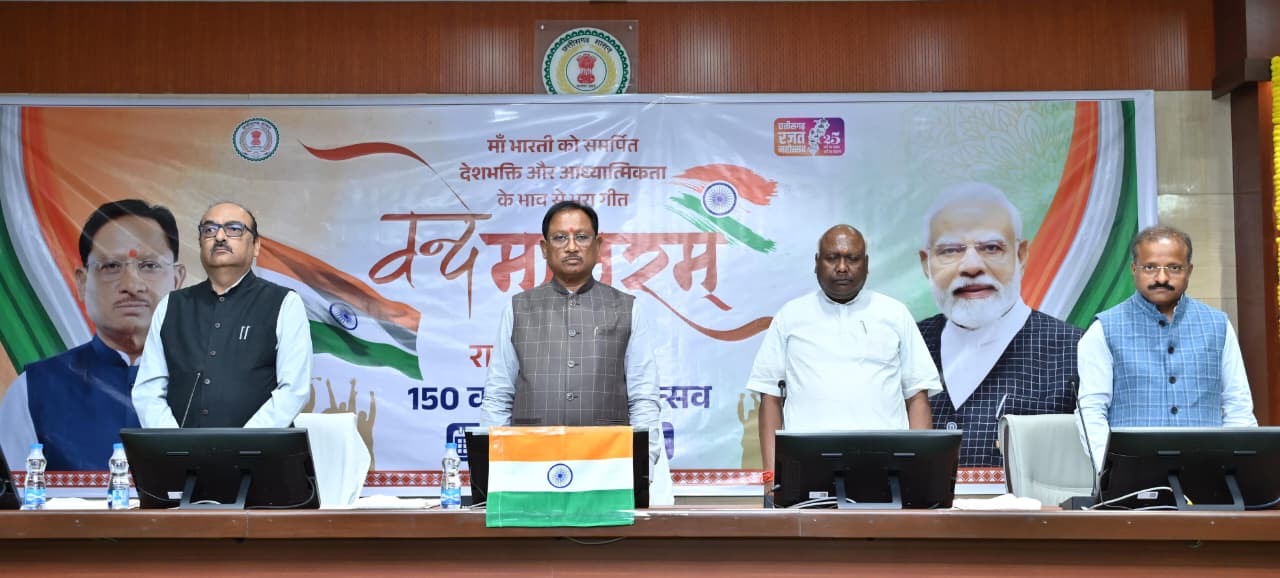
In Chhattisgarh, Chief Minister Vishnu Deo Sai led the state’s observance of the historic occasion at the Mahanadi Bhawan Secretariat, where he joined senior officials and staff in a spirited group rendition of the anthem. The Chief Minister simultaneously participated in the national ceremony held in New Delhi through a live broadcast, during which Prime Minister Narendra Modi addressed the nation.
Prime Minister Modi described Vande Mataram as “a stirring expression of devotion to Mother India,” emphasizing that the anthem’s power lies in its invocation of Bharat Mata — symbolizing India’s identity, resilience, and cultural continuity. He said that the song, which once emboldened revolutionaries and awakened national consciousness, continues to inspire generations with its timeless spirit.
“Vande Mataram was more than a song during the freedom struggle — it was the heartbeat of India’s awakening,” the Prime Minister said. “It carried within it the dreams of a free nation and gave courage to millions to rise against oppression.”
Chief Minister Vishnu Deo Sai echoed this sentiment, calling Vande Mataram “a symbol of boundless love, gratitude, and sacred duty toward the motherland.” He said the nationwide collective singing marked a moment of unity that connected citizens with the soul of India. The Chief Minister also welcomed the release of a commemorative coin and postal stamp by the Prime Minister, calling it “a precious memento of a historic milestone.”
Reflecting on the origins of the anthem, CM Sai recalled that Bankim Chandra Chattopadhyay composed Vande Mataramon November 7, 1875, later immortalizing it in his novel Anandamath. He said the song emerged as the defining force of the Swadeshi Movement and became the unifying cry against colonial rule. “From Bengal to every corner of India, it echoed as the mantra of pride, self-respect, and cultural unity,” he said.
Describing the song as “poetry infused with the fragrance of India’s soil,” the Chief Minister said its message transcends generations. “When one hears Vande Mataram, the heart fills with strength. It reminds us that our motherland nourishes us with her land, her rivers, her culture, and her blessings,” he added.
He invoked the timeless verse from the Ramayana — Janani Janmabhoomishcha Swargadapi Gariyasi — noting that India’s unique civilizational ethos of venerating the motherland is embedded deeply in the song’s spirit.
The Chief Minister urged citizens, especially the youth, to take a solemn pledge to work for a Viksit Bharat and a Viksit Chhattisgarh, dedicating their efforts to Bharat Mata and Chhattisgarh Mahatari. He said the yearlong celebration of the 150th anniversary offers young generations an opportunity to reconnect with the struggles and sacrifices of the past.
As part of the national ceremony, Prime Minister Modi launched the “Vande Bharat Portal” (vandematram150.in), allowing citizens across India to record and upload their own renditions of Vande Mataram. Officials described this as a step toward turning the celebration into a participatory, people-driven movement.
In Raipur, Chief Minister Sai inaugurated a photo exhibition at the Secretariat, tracing the journey of Vande Mataramfrom its creation to its place in India’s freedom struggle. Calling it “an inspiring visual chronicle,” he said the exhibition brings alive the values of courage, cultural unity, and national pride that the song represents.
Among the dignitaries present were Member of Parliament Chintamani Maharaj, Chief Secretary Vikas Sheel, Principal Secretary to the Chief Minister Subodh Kumar Singh, Culture Secretary Dr. Rohit Yadav, and several senior officials and staff.
As the final notes of Vande Mataram echoed across states and districts, India revisited a song that shaped its destiny — a song that remains, even 150 years later, the voice of a nation’s undying devotion and unity.