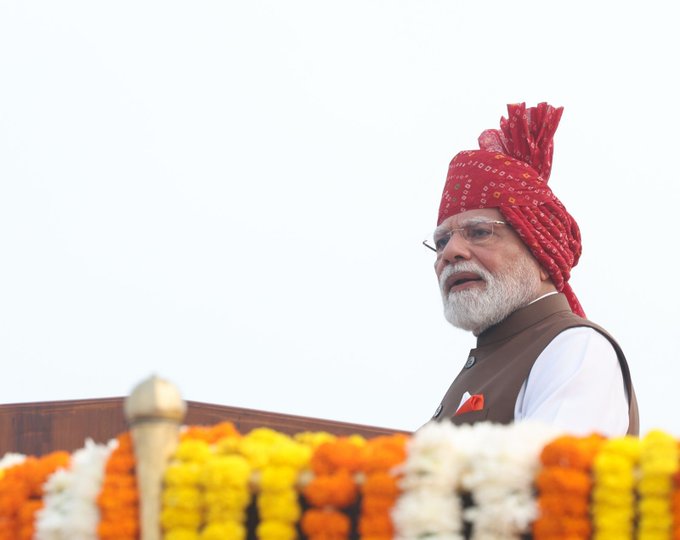
Addressing the nation from Red Fort on 80th Independence Day, Prime Minister unveils Saptadhara strategy, announces AI training for one crore youth, 100 GW nuclear target and nationwide sports talent hunt
TFP Bureau, New Delhi, August 15, 2026: Prime Minister Narendra Modi on Saturday outlined an ambitious roadmap for transforming India into a developed nation by 2047, asserting that the country’s future growth would be driven by self-reliance, manufacturing, technology, agriculture, infrastructure, defence, the green economy and India’s cultural soft power.
Addressing the nation from the ramparts of the Red Fort on the occasion of the 80th Independence Day, Modi said India must set aside limited ambitions and move ahead with “dreams, resolve and strength” to realise the vision of a Viksit Bharat by the centenary of Independence.
Greeting citizens and paying tribute to freedom fighters, the Prime Minister also expressed solidarity with families affected by recent floods and landslides and assured them of the nation’s support.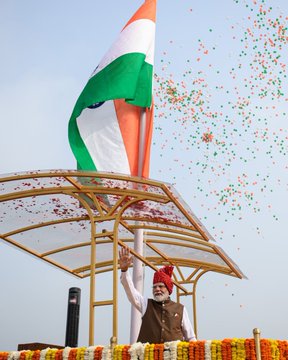
Seven pillars to drive India’s next phase of growth
A major highlight of the address was the Prime Minister’s unveiling of the “Saptadhara” or seven-stream strategy, which he said would provide the foundation for India’s next phase of development.
The seven streams are:
- Manufacturing power — strengthening domestic value chains and making India a reliable global manufacturing hub.
- Agriculture and food processing — promoting modern, sustainable farming and connecting Indian agricultural products with global markets.
- Technology and innovation — expanding capabilities in artificial intelligence, quantum computing, space, robotics, digital infrastructure and 6G.
- Gati Shakti — developing multimodal infrastructure, modern highways, high-speed railways, waterways and port-led growth.
- Defence power — achieving greater self-reliance in defence production and emerging as a global exporter of advanced defence technologies.
- Green and blue economy — expanding renewable energy, green hydrogen, energy storage and the sustainable use of ocean and coastal resources.
- Soft power — promoting yoga, Ayurveda, tourism, culture and the creative economy, including animation, gaming and VFX.
Modi said the seven streams would need to advance together rather than through isolated sectoral growth.
Push for self-reliance and domestic manufacturing
Emphasising the importance of an Aatmanirbhar Bharat, the Prime Minister called upon citizens and businesses to take pride in Indian products and strengthen domestic capabilities.
He urged Indian manufacturers to focus on three key areas — cost, quality and scale — and called for products that are competitive, user-friendly and meet global standards.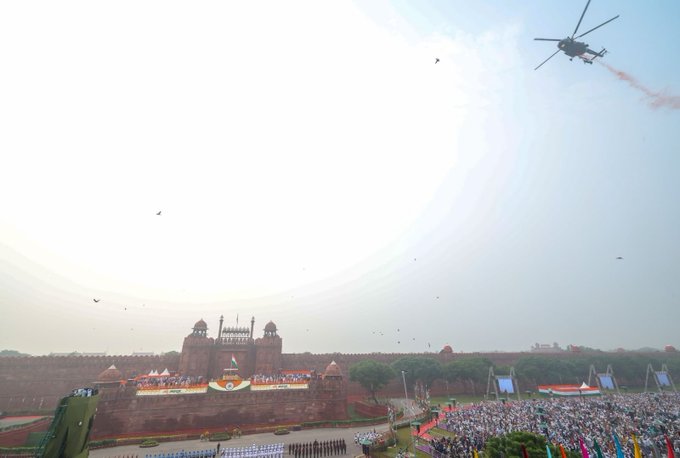
The Prime Minister highlighted the growth of defence production, electronics manufacturing, mobile phone production, railway coach manufacturing and Khadi and Village Industries over the past 12 years as evidence of India’s expanding manufacturing capabilities.
He also highlighted the rapid expansion of digital transactions, internet usage and patent grants.
Semiconductor, nuclear and energy push
Highlighting the importance of strategic technologies and resources, Modi said three semiconductor plants were already operational and exporting chips, while another seven to eight facilities are expected to become operational over the next one to two years.
He also announced an ambitious target of 100 GW of nuclear power capacity by 2047, with five new reactors expected to become operational over the next six to seven years.
The Prime Minister said the government was also strengthening India’s critical mineral security through the National Critical Minerals Mission and Critical Minerals Corridor.
He said the government had opened up 99 per cent of India’s coastline, earlier classified as “No-Go Areas”, for oil and gas exploration and referred to the ₹85,000-crore Samudra Manthan initiative.
Renewable energy and hydrogen technology
Modi highlighted the expansion of India’s renewable energy infrastructure, noting that solar capacity had risen from around 2 GW to 160 GW over the past 12 years.
He said the PM Surya Ghar Muft Bijli Yojana had crossed 50 lakh beneficiary households, enabling families to reduce electricity costs and, in some cases, earn income by selling surplus power.
He also announced progress on India’s first indigenous hydrogen-powered train, describing it as a major step in the country’s emerging clean-energy technology capabilities.
Agriculture remains central to self-reliance
The Prime Minister said farmer welfare remained a key component of India’s development strategy. He highlighted government support for fertiliser prices, noting that urea costing around ₹3,000 in the international market was being made available to farmers for less than ₹300, while DAP costing more than ₹5,000 was being provided at ₹1,350.
He called for greater emphasis on agricultural processing and export-oriented farm-to-market supply chains.
Major focus on youth and AI skills
Placing India’s youth at the centre of the Viksit Bharat mission, Modi announced that the government would train one crore young Indians in artificial intelligence skills over the coming year.
He highlighted the expansion of India’s startup ecosystem, saying the country now had around 2.5 lakh registered startups. He also referred to the ₹1 lakh-crore Research and Innovation Fund and initiatives such as Skill India, Khelo India, the National Drone Policy and the National Education Policy.
The Prime Minister also announced a Free Online Coaching initiative aimed at reducing the financial burden of competitive examinations on middle-class families by providing access to quality teaching through Digital Public Infrastructure.
Sports talent hunt for children
The Prime Minister announced a nationwide sports talent identification programme for children aged 5 to 15 years, with efforts to identify and train promising athletes across villages and schools.
He said India would continue strengthening its sporting ecosystem and referred to the country’s bid for the 2030 Commonwealth Games and its candidature for the 2036 Olympics.
Call for a drug-free India
Modi also called for a nationwide campaign against substance abuse, urging families, NGOs and spiritual organisations to join the Nasha Mukt Yuva Abhiyan.
He proposed a 100-week nationwide campaign to create greater awareness and prevent drug addiction among young people.
Naxalism, security and development
The Prime Minister said areas that had suffered from decades of Naxal violence were now witnessing peace, development and renewed hope. He paid tribute to more than 3,500 security personnel who lost their lives fighting violent extremism.
He said development and the national flag were increasingly reaching areas that had previously remained affected by insurgency.
Modi also announced plans to establish a modern, voluntary Civil Defence network to strengthen preparedness against emerging security threats.
Women’s empowerment gets renewed emphasis
The Prime Minister highlighted the growing contribution of women in aviation, science and technology, defence and entrepreneurship.
He noted that the target of creating three crore “Lakhpati Didis” had already been achieved and set a new target of six crore Lakhpati Didis.
Calling for greater political representation of women, Modi urged political parties to work towards implementing one-third reservation for women in Parliament and state legislatures.
Welfare and digital governance
The Prime Minister said social security coverage had expanded substantially over the past decade, reaching around 100 crore people compared with about 25 crore before 2014.
He highlighted the Ayushman Bharat scheme and said the expansion of health coverage had helped poor and middle-class families avoid significant medical expenditure.
With India’s first Digital Census underway, Modi urged citizens, particularly young people, to actively participate in digital self-registration and ensure accurate demographic data.
‘Make in India’ and global markets
Calling upon Indian companies to expand their international footprint, the Prime Minister urged businesses to develop products that are better and more affordable than competing global products.
He called for ambitious corporate goals, including more Indian companies entering the Fortune 500, the emergence of globally competitive Indian banks and pharmaceutical companies, and stronger Indian leadership in professional and technology services.
He also said India’s stable political mandate, democratic institutions, Constitution and judicial system had strengthened international confidence and helped expand trade opportunities.
Concluding his address, Modi called upon citizens to place national interest above personal interest, overcome a colonial mindset and collectively convert India’s aspirations into measurable achievements.
He said the journey towards a Viksit Bharat by 2047 would require every citizen to contribute to the country’s development and make every step a step towards progress.