Tiger population rises from 18 to 35 in four years; over 3.67 crore saplings planted on 62,441 acres under Kisan Vriksh Mitra Yojana
Raipur, September 1, 2026: Chhattisgarh is pursuing a comprehensive forest conservation strategy that combines environmental protection with the economic empowerment of forest-dependent communities, tribal welfare, wildlife conservation and technology-driven forest management, Forest and Climate Change, Transport, Cooperation and Parliamentary Affairs Minister Kedar Kashyap said on Tuesday.
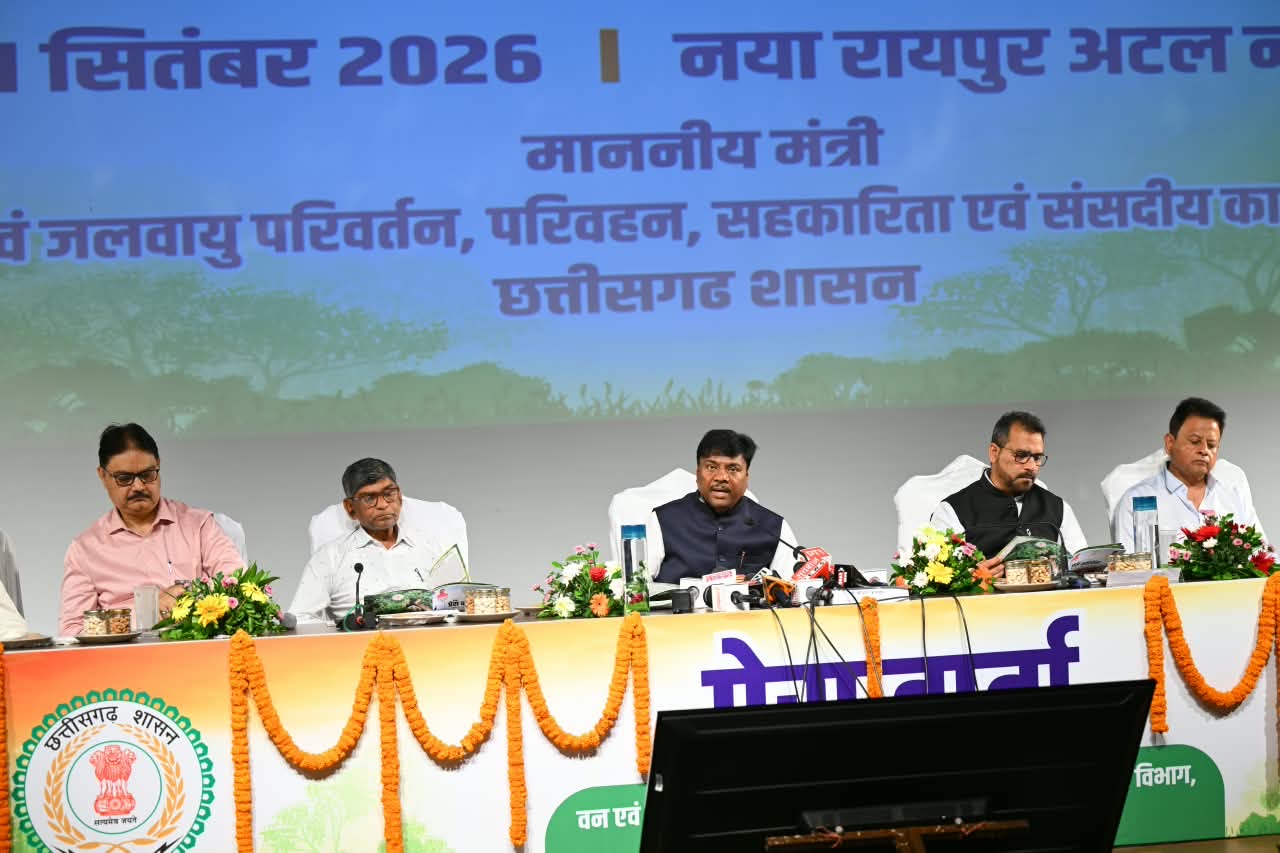
Addressing the media at the Chhattisgarh Samvad Auditorium in Nava Raipur, Atal Nagar, Kashyap said the state government, inspired by Prime Minister Narendra Modi and under the leadership of Chief Minister Vishnu Deo Sai, was working towards the vision of a “Green Chhattisgarh, Prosperous Chhattisgarh”.
“Forest conservation does not mean merely protecting forests,” Kashyap said, stressing that the government’s priorities also include improving the prosperity of forest dwellers, protecting tribal culture, increasing farmers’ incomes, creating employment opportunities for women and youth, conserving wildlife and adopting modern technology for better forest management.
Tree plantation linked to farmers’ income
Under the Kisan Vriksh Mitra Yojana, eligible beneficiaries receive 100 per cent financial assistance for plantations on up to five acres and 50 per cent assistance for areas exceeding five acres.
During the past two years, more than 3.67 crore saplings have been planted across 62,441 acres of agricultural land belonging to 36,896 beneficiaries, the minister said.
Tendu leaf collectors receive higher returns
The government has also focused on improving the incomes and welfare of forest produce collectors. Chhattisgarh offers a tendu leaf collection rate of ₹5,500 per standard bag, described by the minister as the highest in the country.
In 2025, around 11.44 lakh families collected 13.85 lakh standard bags of tendu leaves, for which ₹757 crore was paid online. An incentive remuneration of ₹153 crore was paid to 7.14 lakh collectors.
Under the Charan Paduka initiative, 12.40 lakh women collectors have received footwear, while distribution to 12.38 lakh male collectors has been proposed for 2026.
The state also procured 36,580 quintals of minor forest produce at support prices, with ₹16.66 crore paid online to collectors, benefiting more than 13,000 collector families.
Under the Rajmohini Devi Suraksha Yojana, ₹26.08 crore was disbursed in 1,862 cases. Scholarships worth ₹12.07 crore were provided to 8,533 students from tendu leaf collector families.
In 2026, 13 new tendu leaf collection centres have also been opened in Abujhmad.
Women’s self-help groups gain from forest produce
Kashyap said more than 70,000 members of over 6,000 women’s self-help groups have benefited from the collection and processing of minor forest produce under the Pradhan Mantri Janjatiya Vikas Mission and PM JANMAN scheme.
Women’s groups associated with Van Dhan Kendras have received more than ₹5 crore in commissions, while 181 types of herbal products worth ₹4.42 crore have been produced through the centres.
Women’s groups have also undertaken khas cultivation on 120 acres along the Mahanadi and on unused panchayat land in Dhamtari district. In 65 villages across Gaurela-Pendra-Marwahi, Bilaspur, Kanker, Dhamtari and Korba, 1,854 women have planted 64,798 sinduri and 7,48,092 satavar saplings in their homesteads.
Bastar sees fresh opportunities for employment
Improvement in the security situation in Maoist-affected areas of Bastar has enabled the Forest Department to restart forestry and forest produce operations in highly sensitive areas, the minister said.
Timber and bamboo extraction activities will be undertaken in remote forest areas of Dantewada, Sukma, Bijapur, Bastar, Narayanpur, Kondagaon and Kanker. These activities are expected to generate around 21.67 lakh man-days of employment.
The initiative is aimed at creating local employment, reducing migration and strengthening people’s connection with Bastar’s forests, land and cultural heritage.
Roads, telecom and basic infrastructure expanded
The government is also facilitating basic infrastructure in remote forest areas, including roads, education, healthcare, electricity, drinking water and telecommunications.
Under PM JANMAN, approvals have been granted in 20 cases involving 58.002 hectares and 99.995 km of roads. Under Section 3(2) of the Forest Rights Act, 2006, permissions have been issued in 417 cases for around 1,300–1,400 km of roads following Gram Sabha recommendations.
The Forest Conservation and Promotion Act has also facilitated permissions for 59 of 62 BSNL towers in the districts, with approvals reportedly granted within a record 70 days.
During the past two-and-a-half years, forest diversion proceedings under Section 3(2) of the Forest Rights Act have been completed in 1,168 cases for 13 categories of development works, including schools, hospitals, anganwadis, roads, electricity and telecom lines, drinking water, irrigation, skill development and community centres.
Tiger population nearly doubles
Wildlife conservation has emerged as another major achievement, Kashyap said. The state’s tiger population has increased from 18 in 2022 to 35 in 2026—an increase of 94 per cent.
Spread over 2,829.387 sq km, the Guru Ghasidas-Tamor Pingla Tiger Reserve, notified in 2024, is the country’s third-largest tiger reserve. The National Tiger Conservation Authority has approved the translocation of three tigers from Bandhavgarh, with enclosures and patrolling camps already prepared. The relocation is scheduled after the monsoon.
The blackbuck population in Barnawapara Wildlife Sanctuary has also increased from 77 to more than 200. The achievement was appreciated by Prime Minister Narendra Modi during his ‘Mann Ki Baat’ programme on April 26, 2026.
The minister said 14–17 state-owned wild buffaloes are naturally present in Indravati, while the number of wild buffaloes brought from Assam has increased from six to 11. The population of the state bird, the hill myna, has been recorded at 800–900, while 250 nests have been identified under the Maina Mitra scheme.
A vulture safe zone has been developed at Aurapani in Achanakmar, while 150 vultures belonging to three species are being protected in Indravati Tiger Reserve.
Technology deployed to reduce human-elephant conflict
The state has integrated technology and community participation to address human-elephant conflict through the ‘Gaj Sanket’ app and ‘Gajrath Yatra’.
Kashyap said incidents of human casualties caused by elephants have been declining annually. As many as 90 Hathi Mitra teams comprising 545 trained members are conducting awareness activities in villages.
The ‘Gaj Sanket’ app was launched at Darbha on World Elephant Day on August 12, 2026. The initiative has also received a state-level Good Governance Award from the Chief Minister.
Eco-tourism creates jobs and local income
The state has established 240 natural tourism centres, of which more than 50 have become fully self-sustaining, Kashyap said.
Against a proposed gross income target of ₹2.60 crore for major natural tourism centres, revenue of ₹2.21 crore has been recorded.
Bastar’s Dhudmaras has emerged as an important example of community-based tourism, generating 40 direct and 20 indirect employment opportunities and supporting a five-room ‘Dhuwadera’ homestay.
The Shishupal Eco Trail in Mahasamund has been developed at a cost of ₹45 lakh and has generated 832 man-days and 15 regular livelihood opportunities. In the Kawardha safari model, a new 35-km safari route has been developed, with 4×4 safari vehicles operated directly by the local EDC.
Tribal cultural heritage receives focus
The government is combining forest conservation with protection of Bastar’s tribal cultural heritage. During the past two-and-a-half years, ₹19.05 crore has been spent on the construction and renovation of 572 Dev Gudis in forest areas.
Work has also been undertaken to preserve the traditional ‘Ghotul’ institution at Garhbengal village in Narayanpur district.
Kanger Valley National Park on UNESCO tentative list
Kanger Valley National Park, spread over 200 sq km, was included in UNESCO’s tentative list in 2025. The park is known for its caves, Tirathgarh waterfalls and rich biodiversity.
Under the revolving fund, 35 Gypsy vehicles have been provided for tourism activities, creating direct and indirect employment for around 200 local youth. Eighteen beneficiaries have already repaid their loans in full.
Forest management committees promote rural livelihoods
Benefits from the dividends of Joint Forest Management Committees are being used to promote livelihood activities such as beekeeping, poultry farming, fisheries, goat rearing, ginger cultivation, eucalyptus plantation and incense-stick production.
Intensive fish farming has been undertaken in 78 ponds, producing around 3,200 quintals of fish as of June 30, 2026. During the past two-and-a-half years, ₹2,170.15 lakh in loans has been provided through the revolving fund, benefiting 700 families.
Kopra Reservoir becomes Chhattisgarh’s first Ramsar site
Kopra Reservoir in Bilaspur has been declared Chhattisgarh’s first Ramsar site, the minister said. Under Vision@2047, the state has set a target of creating 20 Ramsar sites by 2030.
Ground-truthing and boundary demarcation have been completed for 11,096 wetlands measuring more than 2.25 hectares. More than 500 Wetland Mitras are working across the state, while 105 youth from Biodiversity Management Committees have received para-taxonomy training.
Digital forest administration strengthened
The Forest Department has fully digitised its payment process from end to end and integrated it with the Reserve Bank of India’s e-Kuber and e-Kosh platforms.
More than ₹1,520 crore was paid online during financial year 2025-26, while ₹209 crore had been paid online up to August 2026 in FY 2026-27.
A total of 8,975 officers and employees have been onboarded on SPARROW, with 9,464 PARs generated. The eHRMS platform has 32,869 officers and employees onboarded, while e-Office has been implemented 100 per cent from the headquarters to the divisional level. Another 9,230 officers and employees have been onboarded on iGOT Karmayogi.
The state is also operating an advanced forest fire alert and monitoring system that provides near-real-time alerts. The response time to forest fires has been reduced from 1–2 hours to just 5–10 minutes, with the system now being expanded to the beat level.
The minister said these initiatives reflect the government’s broader approach of combining forest protection with livelihood generation, technological modernisation, wildlife conservation and inclusive development.