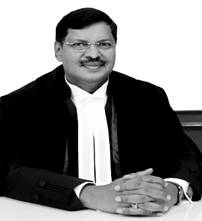
TFP Bureau, New Delhi, April 30, 2025: In a significant development in the Indian judiciary, the President of India has appointed Justice Bhushan Ramkrishna Gavai as the next Chief Justice of India (CJI). He will assume office on 14th May 2025, succeeding incumbent Chief Justice D.Y. Chandrachud.
The official notification, issued by the Department of Justice, Government of India, follows the President’s formal signing of the warrant of appointment.
Born on 24 November 1960 in Amravati, Maharashtra, Justice Gavai brings with him an illustrious legal career spanning four decades. He enrolled at the Bar in March 1985 and began his legal journey under the mentorship of Barrister Raja S. Bhonsale, a former Advocate General and High Court Judge. He practiced at the Bombay High Court and later, extensively at its Nagpur Bench, handling matters primarily related to constitutional and administrative law.
Justice Gavai has served as Assistant Government Pleader, Additional Public Prosecutor, and subsequently, as Government Pleader for the Nagpur Bench. He was elevated as an Additional Judge of the Bombay High Court in 2003and became a permanent judge in 2005. His elevation to the Supreme Court came on 24 May 2019.
Over his six-year tenure at the apex court, Justice Gavai has been part of nearly 700 Benches, authoring over 300 judgments across diverse domains including constitutional, criminal, civil, commercial, environmental, and arbitration law. He has also been part of Constitution Bench rulings upholding democratic values, fundamental rights, and judicial independence.
Justice Gavai has represented India at international judicial forums in Mongolia, the United States, the United Kingdom, and Kenya. He has also lectured at prestigious institutions such as Columbia University and Harvard University on constitutional and environmental matters.
Justice Gavai, who is set to retire on 23 November 2025, will serve as the 51st Chief Justice of India. His appointment also marks a significant moment as he becomes one of the few Chief Justices from the Scheduled Caste community, reinforcing India’s commitment to inclusivity and representation in the judiciary.