
* Historic procurement by January 13 accompanied by strict monitoring of moisture loss, storage norms and transparency mechanisms
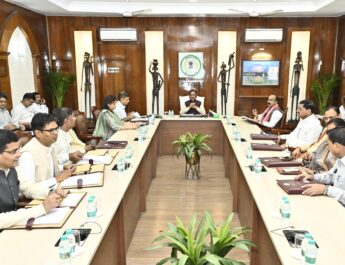
TFP Bureau, Raipur, January 15, 2026: Chhattisgarh has set a new benchmark in paddy procurement during the ongoing Kharif Marketing Season 2025–26, reinforcing its status as one of India’s leading agrarian states. Under the leadership of Chief Minister Shri Vishnu Deo Sai, the state has achieved its highest-ever procurement and payment figures by January 13, with ₹23,448 crore transferred directly into the bank accounts of 17.77 lakh farmers.
As per official data, a total of 105.14 lakh metric tonnes (LMT) of paddy has been procured so far this season, marking the highest quantity procured by this date in any previous year. The scale of procurement and the timely disbursal of payments reflect the government’s commitment to transparent, farmer-friendly policies and efficient administration.
A comparison with previous years underlines the significance of this achievement. By January 13 of the Kharif Marketing Season 2020–21, the state had procured 72.15 LMT of paddy from 17.49 lakh farmers, disbursing ₹13,550 crore. In 2021–22, procurement stood at 68.77 LMT from 17.09 lakh farmers with payments of ₹13,410 crore. In 2022–23, procurement rose to 97.67 LMT from 22.14 lakh farmers, with ₹20,022 crore paid. The current season has surpassed all these figures, both in terms of quantity procured and the amount credited to farmers.
Officials said the record-breaking performance demonstrates the effectiveness of the state’s streamlined procurement system, digital tracking of stocks and assured, time-bound payments. Farmers are receiving the minimum support price directly through a centralized Direct Benefit Transfer system, which has strengthened confidence in government mechanisms and provided a significant boost to the rural economy.
At the same time, the government has reiterated that there will be no compromise on accountability in procurement and storage. Strict action has been taken against irregularities related to drying loss and storage shortages during previous seasons. In cases where shortages of more than 0.5 per cent but less than 1 per cent were detected, show-cause notices were issued to in-charge officers. Departmental inquiries were initiated where shortages ranged between 1 and 2 per cent, while officers at centres with shortages exceeding 2 per cent were suspended and subjected to disciplinary proceedings. FIRs were registered wherever criminal intent was found.
Over the last two years, show-cause notices have been issued to 33 food inspectors and food officers for negligence and irregularities. FIRs have been registered against in-charges of two procurement centres, and one officer has been suspended. Additionally, for drying losses during the Kharif Marketing Season 2023–24, notices were issued to six District Marketing Officers and six procurement centre in-charges, reinforcing the state’s zero-tolerance stance towards corruption and laxity.
Addressing concerns raised in some quarters regarding moisture loss and pest-related damage during storage, officials clarified that a certain reduction in weight due to loss of moisture—commonly known as drying loss—is a natural and scientific process observed nationwide. Official records show moisture loss of 6.32 per cent in KMY 2019–20 and 4.17 per cent in 2020–21, indicating that such losses are neither new nor abnormal. For KMY 2024–25, an estimated moisture loss of around 3.49 per cent has been projected, which falls well within historical averages.
Experts explained that factors such as moisture content at procurement, temperature, storage duration, transportation and environmental conditions naturally lead to some weight reduction. While this process cannot be entirely eliminated, it is now being scientifically measured, regulated and monitored. Losses within prescribed limits are treated as normal, while any abnormal deviation automatically triggers scrutiny and investigation.
The state has introduced robust technological safeguards, including digital stock entries at procurement centres, quality testing, warehouse and transportation tracking, and continuous monitoring of lifting operations. Paddy lifting for the Kharif Marketing Season 2024–25 is currently underway, along with the disposal of auctioned stock. A final assessment of total drying loss will be possible only after complete disposal of all procured paddy.
It is also noteworthy that while the Government of India had set a central pool target of 78 lakh metric tonnes of rice, Chhattisgarh procured approximately 116 lakh metric tonnes of paddy. Due to limited milling and storage capacity with the Food Corporation of India, final disposal took 12 to 15 months in some cases, contributing to natural drying losses.
Officials emphasised that the state’s overarching objective is to safeguard farmers’ money, grain and trust. With digital tokens, online payments, stock tracking and grievance redressal systems in place, Chhattisgarh’s paddy procurement mechanism has emerged as one of the most transparent and closely monitored in the country, ensuring fair prices, timely payments and strict accountability at every stage.