State adds 683 sq km of forest area, tiger numbers double, and new conservation, plantation and livelihood schemes boost ecology and rural economy.
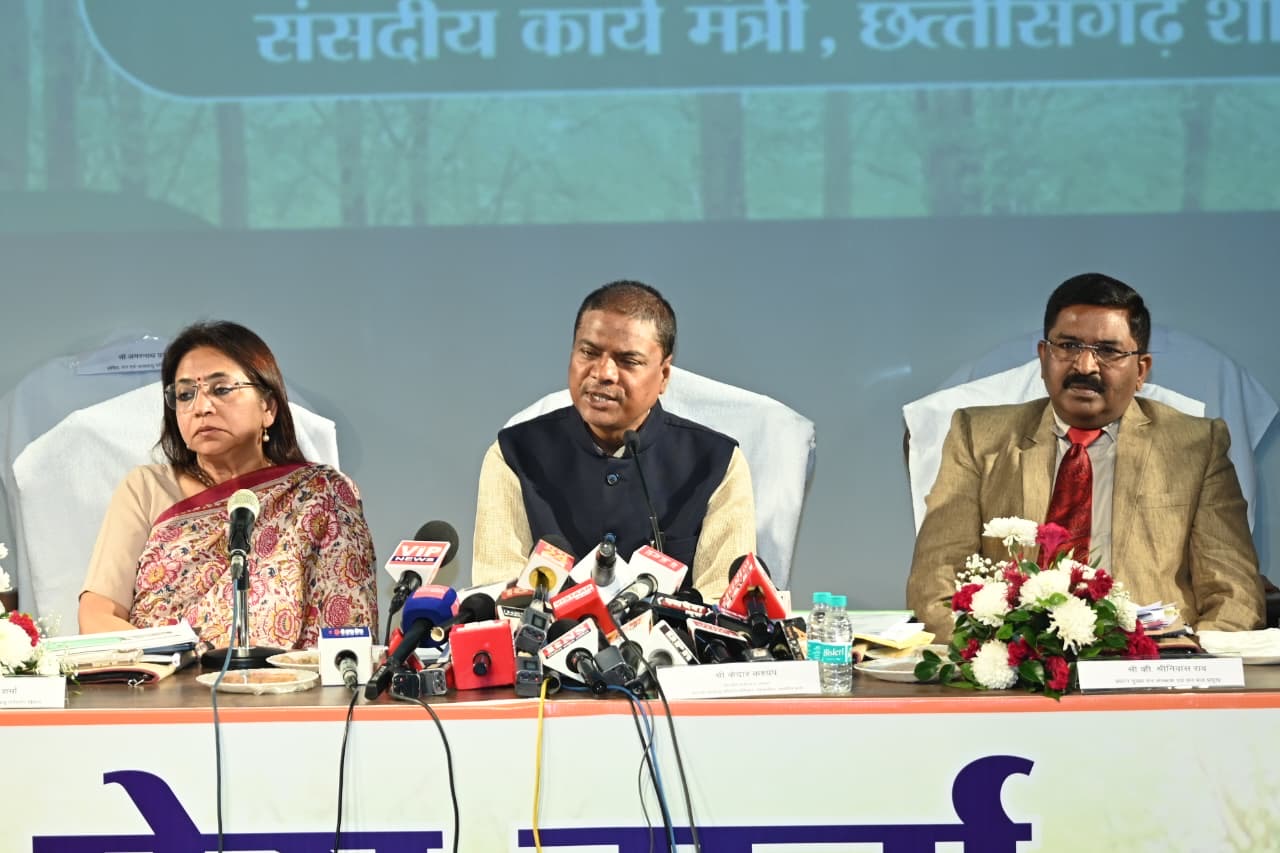
TFP Bureau, Raipur, February 12, 2026: Chhattisgarh has registered significant progress in forest conservation, biodiversity protection, eco-tourism development and livelihood generation for forest-dependent communities, State Forest, Cooperation and Transport Minister Kedar Kashyap said while addressing a press conference at the Chhattisgarh Samvad auditorium on Wednesday. Highlighting the department’s recent initiatives and outcomes, the minister stated that the government is pursuing a balanced approach that combines environmental sustainability with economic empowerment of local communities.
Citing the latest Forest Survey of India report released in December 2024, Kashyap said the state’s total forest and tree cover has increased by about 683 square kilometres, bringing nearly 44 percent of Chhattisgarh’s geographical area under green cover. He noted that the addition of 348 square kilometres in the Very Dense Forest category reflects improved forest quality, ecological stability and strengthened conservation measures.
The minister pointed to mass plantation drives as a key contributor to this growth. Under the “Ek Ped Maa Ke Naam 2.0” campaign, over 4.2 crore saplings were planted and distributed across the state in 2024, followed by more than 2.79 crore saplings in 2025. He said the initiative not only enhances green cover but also encourages public participation in environmental protection.
To boost farmers’ incomes while expanding tree cover, the government is implementing the Farmer Tree Friend Scheme, which promotes commercial plantation on private land. Beneficiaries receive full financial assistance for plantations up to five acres and 50 percent subsidy beyond that. Over the past two years, more than 3.67 crore saplings have been planted across 62,441 acres belonging to 36,896 farmers, he added.
In a cultural conservation initiative, 435 Devgudis—traditional tribal deity sites—have been constructed in the last two years at a cost of about ₹16.17 crore. The project, undertaken in line with a national commitment to preserve indigenous traditions, aims to protect sacred tribal spaces while reinforcing community identity.
The minister also outlined recruitment progress within the Forest Department, noting that 313 Class III posts have been filled in the past two years and compassionate appointments have been granted to 150 dependents of deceased employees. Physical tests for 1,484 forest guard posts have been completed and further recruitment processes are underway to strengthen field-level forest protection.
Wildlife conservation efforts have yielded visible results, Kashyap said. The state’s tiger population has risen from 17 in 2022 to 35, supported by the creation of the Guru Ghasidas-Tamor Pingla Tiger Reserve and improved habitat management. Approval has also been secured to relocate tigers from other reserves to further strengthen the population.
Special programmes are being implemented for other key species as well. A conservation strategy is being prepared for the wild buffalo, the state animal, with recent sightings of 14 to 17 individuals reported from Indravati Tiger Reserve. To protect the state bird, the hill myna, local youth have been enlisted as “Myna Mitra” volunteers, leading to sightings of around 600 to 700 birds.
The minister said eco-tourism is emerging as an important driver of sustainable development. A Bird Interpretation Centre and Bird Safari inaugurated at Gidhawa-Parasada hosts more than 270 bird species, attracting nature enthusiasts and researchers. Meanwhile, the Kopra Reservoir in Bilaspur district has been designated the state’s first and the country’s 96th Ramsar Site, a recognition expected to enhance tourism, conservation and employment opportunities.
According to Kashyap, the state has established 240 nature tourism centres, more than 50 of which have become financially self-sustaining. Infrastructure development has also been undertaken in forest areas, including construction of 96 culverts and bridges to improve connectivity for forest dwellers.
Addressing human-wildlife conflict, he said elephant movement in affected regions is being tracked through the ‘Gaj Sanket’ mobile application, which sends timely alerts to villagers. Ninety Elephant Friendship Teams have been formed to assist communities, and a total of 355 elephants are currently recorded in the state.
The minister further highlighted livelihood initiatives for women through medicinal plant cultivation programmes run by the State Medicinal Plant Board. These projects have generated employment for thousands of women and included training for traditional healers to strengthen indigenous healthcare knowledge systems.
Detailing the work of the State Forest Development Corporation, Kashyap said it has undertaken timber production, plantation, encroachment removal and implementation of e-office systems under sustainable forestry principles. Timber and forest produce are now being sold through e-auction to ensure transparency. Under the Forest Rights Act, land use approvals have been granted in 1,165 cases to facilitate development works such as roads, schools, healthcare centres and drinking water facilities in tribal regions.
He also highlighted the Marine Fossil Park in Manendragarh-Chirmiri-Bharatpur district, describing it as the largest marine fossil park in Asia. Spread over about one kilometre along the Hasdeo River, the site contains fossils dating back nearly 290 million years and is one of only four such marine fossil locations identified in the country.
The minister said the state government remains committed to strengthening conservation efforts while ensuring that forest-dependent communities benefit directly from sustainable development initiatives, adding that Chhattisgarh’s integrated model of ecology and livelihoods could serve as a template for other states.