
Senior officials of four states and Centre deliberate on 50-point agenda, share best practices ahead of Council meeting
TFP Bureau, Raipur, January 30, 2026: Senior officials of Chhattisgarh, Madhya Pradesh, Uttar Pradesh, Uttarakhand and the Union Government held extensive deliberations on issues of socio-economic development, effective implementation of government schemes and inter-state coordination during the 17th meeting of the Standing Committee of the Central Zonal Council, held in Nava Raipur on Friday. The meeting focused on a detailed 50-point agenda covering administrative, economic and social matters concerning the central region states, with an emphasis on resolving pending issues and strengthening cooperative federalism.
The Standing Committee meeting holds particular importance as it finalises the agenda for the forthcoming Central Zonal Council meeting. Recommendations and decisions taken during the deliberations will be placed before the main council for further consideration. The forum also serves as a platform to address long-pending inter-state issues, enhance policy coordination and remove practical bottlenecks affecting development projects across the member states.
The meeting was chaired by Chhattisgarh Chief Secretary and Chairperson of the Standing Committee, Shri Vikas Sheel, and attended by Secretary, Inter-State Council Secretariat, Ministry of Home Affairs, Shri Ashish Srivastava, Additional Secretary Smt. Shubha Thakur, Madhya Pradesh Additional Chief Secretary Smt. Rashmi Arun Shami, Uttar Pradesh Additional Chief Secretary Shri Parth Sarathi Sen Sharma, Uttarakhand Principal Secretary Shri Ramesh Kumar Sundashu, along with senior officials from various Union ministries and departments of the four states.
Addressing the gathering, Chief Secretary Shri Vikas Sheel said the discussions were constructive and outcome-oriented, focusing on issues of mutual concern to the states and the Centre. He emphasised that continuous dialogue and coordination among states would help safeguard shared interests and ensure balanced development in the central region. Shri Ashish Srivastava, Secretary, Inter-State Council Secretariat, urged the states to initiate prompt action on the outcomes of the meeting, noting that regular consultations between the Centre and states would lead to practical solutions to common challenges.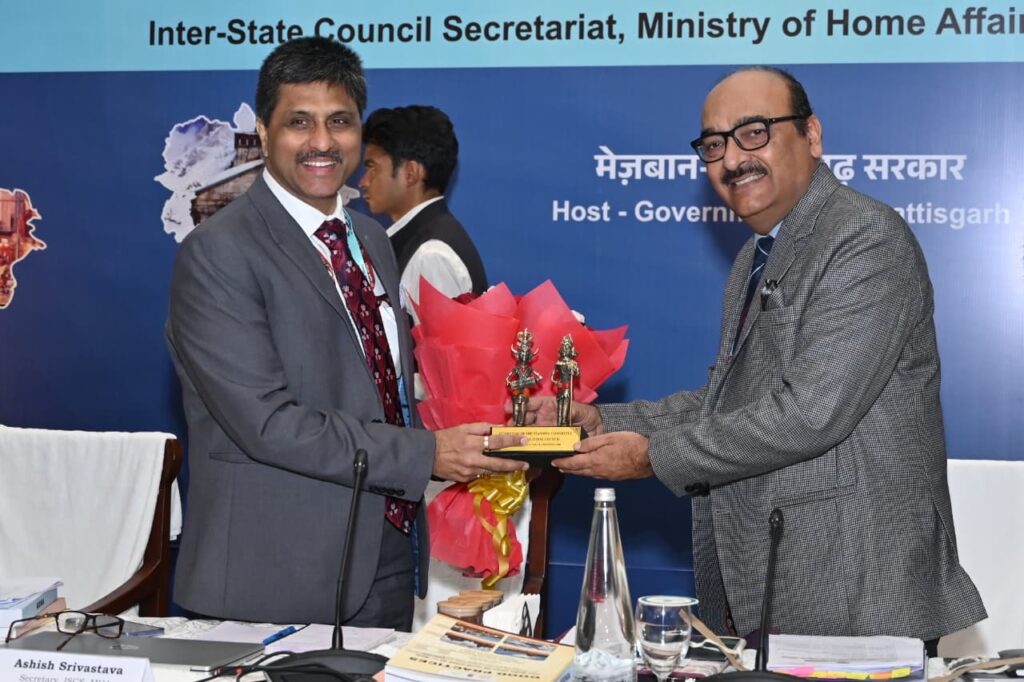
The Standing Committee discussed matters related to a wide range of Union ministries and departments, including Panchayati Raj, Law and Justice, Home Affairs, Cooperation, Women and Child Development, Health and Family Welfare, Power, Housing and Urban Affairs, Rural Development, Railways, Mines, Social Justice and Empowerment, Electronics and Information Technology, Coal, Civil Aviation, Environment, Forest and Climate Change, Jal Jeevan Mission, Food Safety and Standards Authority of India, School Education and Literacy, Food and Public Distribution, Financial Services, Posts, Animal Husbandry and Dairying, Commerce and Fisheries.
A key highlight of the meeting was the presentation of best practices and innovations adopted by the four states to improve governance and development outcomes. Chhattisgarh showcased its One-Click Single Window System 2.0, launched in July 2025, which integrates more than 136 services across 16 departments to fast-track industrial investment, land management, environmental clearances and subsidy approvals. The state also presented the Dantewada Model of blockchain-based secure land records and the AI-driven Vidya Samiksha Kendra as notable innovations in education governance.
Madhya Pradesh highlighted its rural tourism development initiative promoting homestays and culture-based tourism in 125 villages, along with its Energy Conservation and Renewable Energy Policy–2025, which targets sourcing 50 per cent of electricity from renewable energy by 2030. The state also shared details of the PM Shri Tourism Heli Service aimed at improving tourism and regional connectivity.
Uttarakhand presented initiatives such as income enhancement of border farmers through a Farmer-to-ITBP supply chain, plastic waste management via a digital deposit refund system, and rejuvenation of water sources through the Spring and River Rejuvenation Authority. Uttar Pradesh officials shared information on urban housing improvement initiatives, the Labour Justice Setu Portal and citizen-centric innovations such as Seva Mitra.
The meeting concluded with a consensus on strengthening inter-state cooperation and expediting follow-up action to ensure effective implementation of the decisions taken, reinforcing the spirit of cooperative and competitive federalism in the central region.