Focused on inclusive growth, infrastructure expansion, investment promotion and human capital development, the third budget of the state government aims to accelerate Chhattisgarh’s journey towards the ‘Chhattisgarh Anjor 2047’ vision.
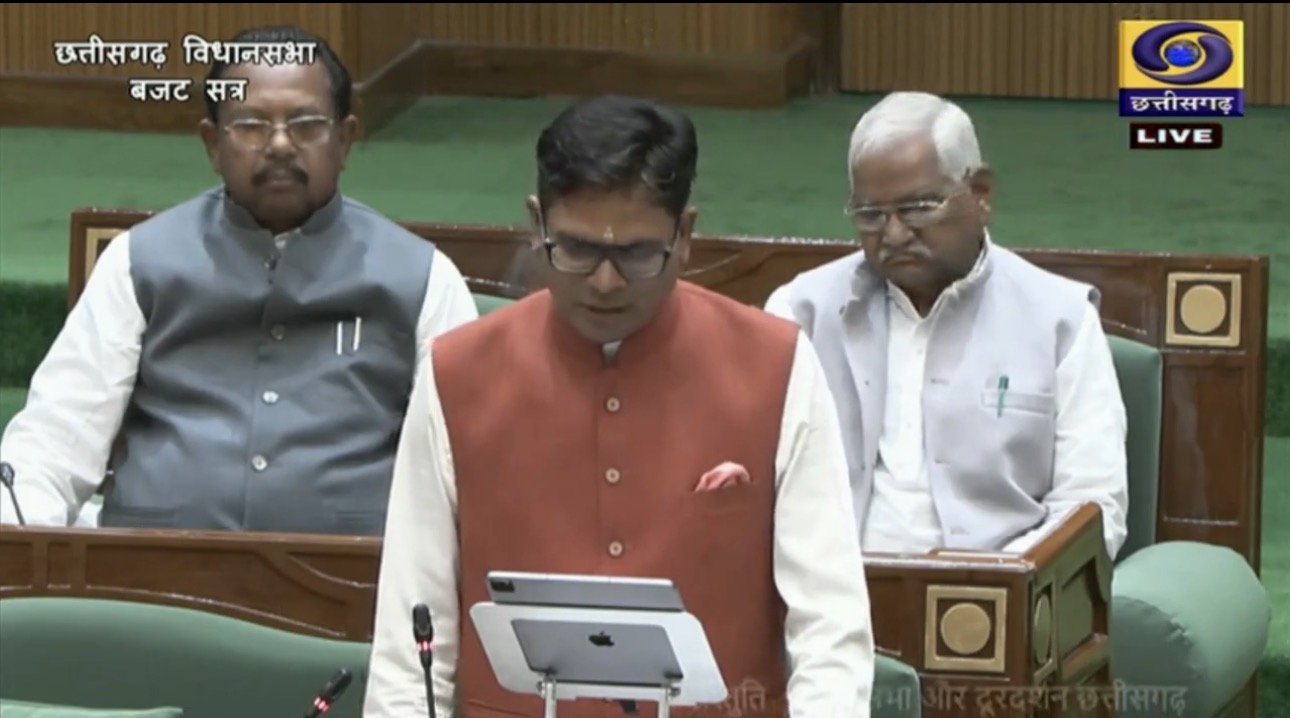
TFP Bureau, Raipur, February 24, 2026: The Chhattisgarh government on Monday presented a comprehensive and future-oriented Budget for the financial year 2026–27, laying out a detailed roadmap to accelerate economic growth while ensuring social justice and balanced regional development. The budget was tabled in the State Legislative Assembly by Finance Minister Shri O.P. Choudhary under the leadership of Chief Minister Vishnu Deo Sai, marking the third budget of the present government.
Centred on the theme ‘SANKALP’, the budget seeks to translate policy intent into visible outcomes on the ground. The government described SANKALP as a commitment to move beyond formulation of schemes to their effective implementation, ensuring that the benefits of development reach every citizen and every region of the state.
Continuity of Vision: From GYAN and GATI to SANKALP
Building on the guiding principles of the previous two budgets—GYAN (Garib, Yuva, Annadata, Nari) and GATI (Good Governance, Accelerating Infrastructure, Technology and Industrial Growth)—the 2026–27 budget integrates these ideas into a single, result-driven framework. The objective, according to the government, is to ensure inclusive growth, employment generation, skill development, and robust infrastructure while strengthening governance mechanisms.
The budget aligns with the long-term vision document Chhattisgarh Anjor 2047, aiming to place the state firmly on the path of sustained and equitable development over the next two decades.
Key Fiscal Highlights
The Gross State Domestic Product (GSDP) for 2026–27 is projected at ₹7.09 lakh crore, reflecting a growth rate of 12.4 per cent over the revised estimates of the previous year. Total budget size has been pegged at ₹1.72 lakh crore, up from ₹1.65 lakh crore in 2025–26, underlining the government’s intent to maintain fiscal momentum while adhering to financial discipline.
Capital expenditure has been fixed at ₹26,500 crore, accounting for over 15 per cent of the total budget and 3.7 per cent of GSDP, signalling continued focus on infrastructure creation. The fiscal deficit has been estimated at 2.87 per cent of GSDP, well within the limits prescribed under the Fiscal Responsibility and Budget Management (FRBM) Act.
Inclusive Development at the Core
A major thrust of the budget is on inclusive development, with targeted provisions for Scheduled Tribes, Scheduled Castes, farmers, women, youth and other vulnerable sections. The government reiterated its commitment to bridging regional disparities and ensuring equitable access to basic services such as healthcare, education, drinking water and housing.
Special emphasis has been laid on strengthening rural livelihoods, modernising agriculture, promoting allied activities and enhancing income opportunities in tribal-dominated regions such as Bastar and Surguja.
Flagship Schemes and Welfare Initiatives
Among the major allocations, the Krishak Unnati Yojana received a provision of ₹10,000 crore to promote modern farming practices, improve productivity and encourage crop diversification. The Mahtari Vandan Yojana, aimed at empowering women socially and economically, has been allocated ₹8,200 crore.
Food security remains a priority, with ₹6,500 crore earmarked for the Chief Minister Food Assistance Scheme. To reduce the financial burden on households and farmers, the government has allocated ₹6,700 crore towards power subsidies, including free electricity for agricultural pumps up to five horsepower and relief for domestic consumers.
In the housing sector, ₹4,000 crore has been set aside for the Pradhan Mantri Awas Yojana (Rural), while healthcare has received a significant boost with ₹1,500 crore allocated for the Shaheed Veer Narayan Singh Ayushman Health Scheme, ensuring free treatment facilities for citizens.
New Schemes and Development Initiatives
The budget introduces several new schemes, including Viksit Bharat G RAM G Yojana, with an allocation of ₹4,000 crore to guarantee 125 days of employment annually in rural areas and strengthen village-level infrastructure. Urban development will be supported through the Mukhyamantri Adarsh Shahar Samriddhi Yojana, while faster road connectivity is planned under the Mukhyamantri Drutgami Sadak Sampark Yojana.
To enhance educational quality, the Swami Vivekanand Utkrisht School Yojana has been allocated ₹100 crore, and a cashless medical facility scheme for state government employees has also been announced.
Five Chief Ministerial Missions
A distinctive feature of the 2026–27 budget is the launch of five Chief Ministerial Missions to drive focused development. These include the Chief Minister AI Mission to promote artificial intelligence-based innovation, the Sports Excellence Mission, the Tourism Development Mission, the Infrastructure Mission, and the Startup and NIPUN Mission aimed at skill development and entrepreneurship among youth. Each mission will receive at least ₹100 crore annually over the next five years.
Sector-wise Focus
Education, health, agriculture, women and child development, energy, public works and social welfare continue to receive substantial allocations. Major investments have also been proposed for industrial parks, land banks, electronics manufacturing clusters, tourism infrastructure and cultural heritage conservation.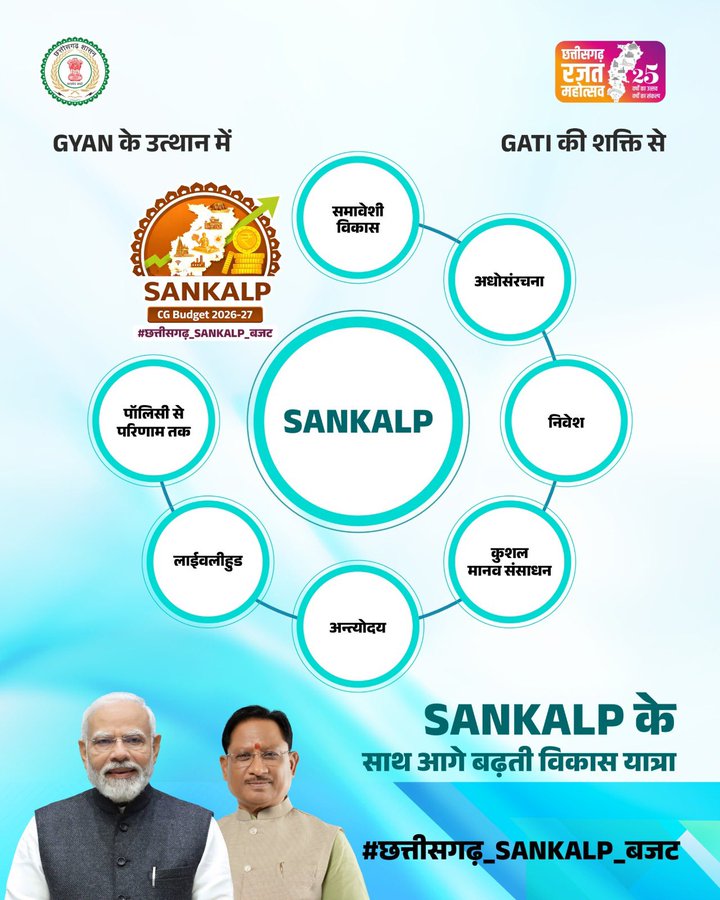
Commitment to Implementation
Presenting the budget, Finance Minister Shri O.P. Choudhary said the SANKALP-based approach reflects the government’s resolve to ensure that policies result in measurable impact. Chief Minister Vishnu Deo Sai described the budget as a strong step towards accelerating development, creating employment opportunities and preparing the youth of Chhattisgarh for future challenges.
As Chhattisgarh completes 25 years of statehood, the 2026–27 budget seeks to build on past achievements while setting the foundation for a prosperous, inclusive and resilient future.