Ten-Day Programme Under DPIIT-IPR Chair Brings Together Academics, Researchers and Practitioners to Deliberate on Global Trends in Intellectual Property Law
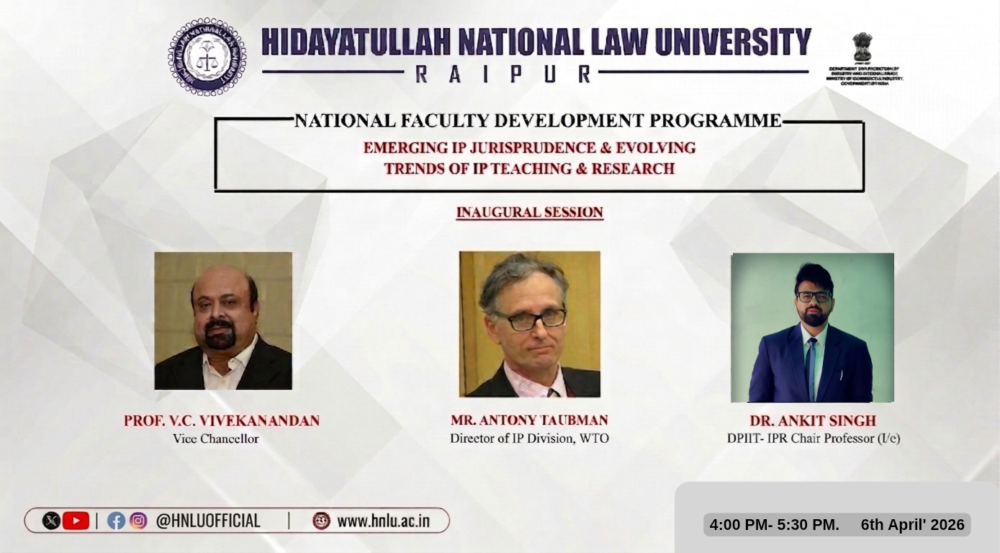
TFP Bureau, Raipur, April 8,2026: Antony Taubman, Director of the Intellectual Property Division at the World Trade Organization, delivered the inaugural lecture at a Ten-Day National Faculty Development Programme (FDP) hosted by Hidayatullah National Law University (HNLU), Raipur. The programme, organised under the university’s DPIIT-IPR Chair initiative, focuses on the theme “Emerging IP Jurisprudence and Evolving Trends of IP Teaching & Research.”
The FDP, being held from April 6 to April 16, aims to create a robust academic platform for faculty members, researchers, legal practitioners and industry professionals to engage with contemporary developments in intellectual property (IP) law. It seeks to strengthen doctrinal clarity, enhance research competencies and foster interdisciplinary scholarship in a rapidly evolving global innovation landscape.
In his keynote address, Mr. Taubman highlighted the increasing centrality of intellectual property in shaping global trade, innovation ecosystems and knowledge-driven economies. He stressed that intellectual property law today operates within a complex matrix of international treaties, trade frameworks and technological transformations. Addressing participants virtually, he underscored the importance of adaptive and forward-looking legal frameworks capable of responding to disruptive technologies such as artificial intelligence, biotechnology and digital platforms.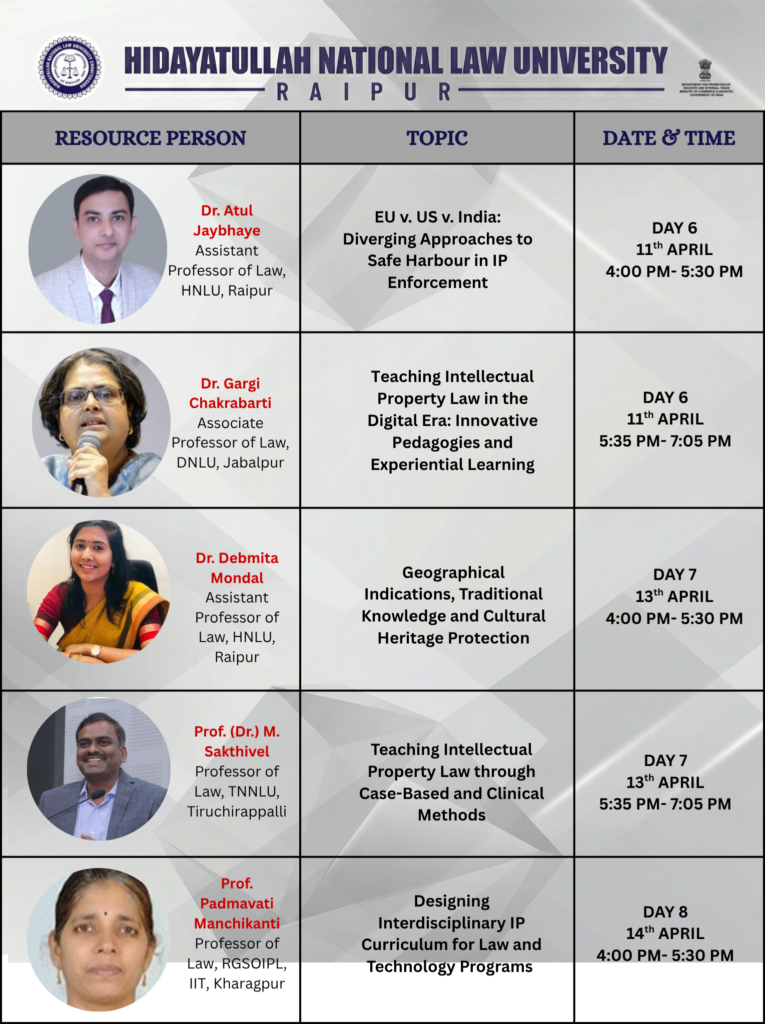
Mr. Taubman also examined the relationship between the World Intellectual Property Organization (WIPO) and the WTO from an international law perspective, drawing attention to areas of convergence and divergence in their mandates and institutional approaches. He elaborated on how global IP governance has evolved over time, particularly following the TRIPS Agreement, and emphasised the need for academic institutions to actively contribute to critical discourse and policy development in the field.
Earlier, Prof. Vivekanandan, Vice Chancellor of HNLU, in his opening remarks, emphasised the transformation of innovation from laboratories and research centres into marketable assets within a globally integrated economy. He noted that understanding the “regime complex” of intellectual property—comprising overlapping international agreements, institutions and domestic laws—is essential for scholars and policymakers alike. He encouraged participants to approach IP not merely as a technical legal subject but as a dynamic field intersecting with trade, development, public policy and technology.
The Faculty Development Programme comprises 20 intensive sessions of 90 minutes each, carefully curated to cover doctrinal developments, comparative jurisprudence, pedagogical innovations and emerging research methodologies in IP law. The sessions feature leading experts from academia, the bar and the bench, offering diverse perspectives on patent law, copyright, trademarks, geographical indications, trade secrets and emerging digital rights issues.
The programme has attracted more than 70 registered participants, including law faculty members from universities across India, doctoral researchers and industry professionals engaged in IP practice and policy. Organisers said the strong response reflects growing academic and professional interest in strengthening intellectual property scholarship in line with India’s innovation-driven growth strategy.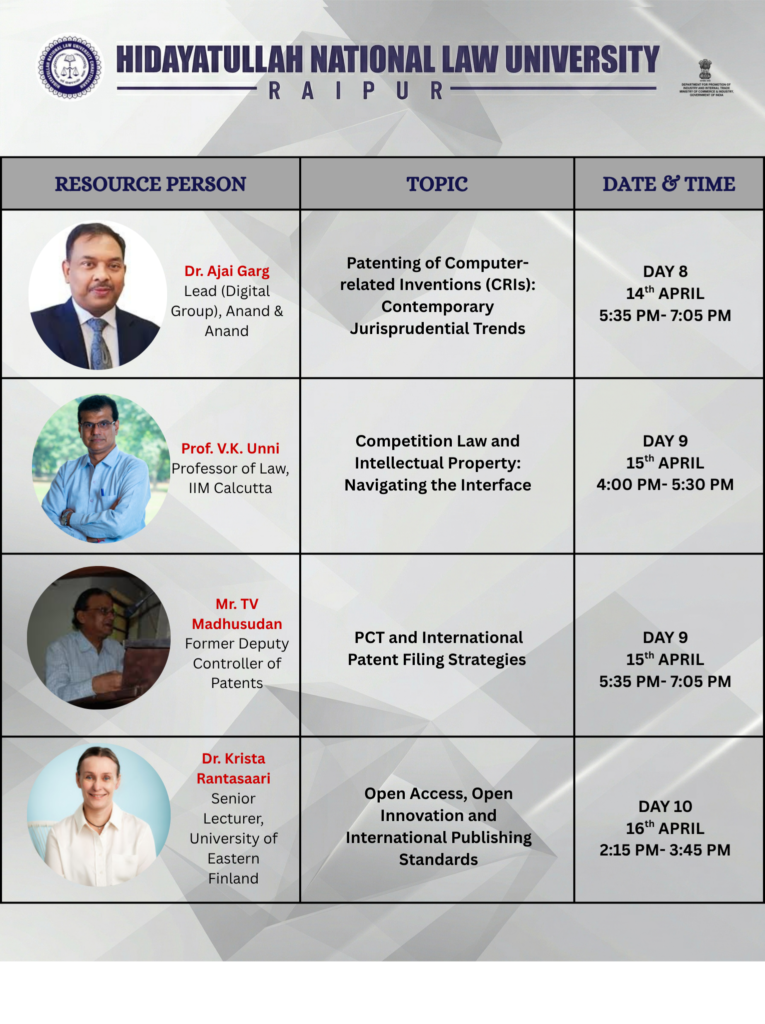
The FDP has been curated by Dr. Ankit Singh, IP Chair In-Charge at HNLU, along with his team under the DPIIT-IPR Chair framework. The initiative aligns with the national vision of fostering a knowledge-based economy, promoting research excellence and building institutional capacity in intellectual property law.
Officials at HNLU stated that beyond doctrinal learning, the programme seeks to promote collaborative research, encourage publication in high-impact journals and build networks among IP scholars and practitioners. By facilitating dialogue between global experts and Indian academics, the university aims to position itself as a hub for advanced research and discourse in intellectual property law.
The inaugural lecture by Mr. Taubman set the tone for in-depth deliberations over the coming days, as participants explore emerging jurisprudential trends and evolving approaches to teaching and researching intellectual property in an increasingly interconnected world.