
Fifth Mahatma Gandhi Memorial Lecture explores the unfinished project of the Indian Republic; new academic publications and student initiatives also unveiled
TFP Bureau, Raipur, August 16, 2026: Hidayatullah National Law University (HNLU) celebrated the 80th Independence Day with patriotic fervour, featuring the hoisting of the National Flag, a cultural programme, the Fifth Mahatma Gandhi Memorial Lecture and several academic and student initiatives.
The celebrations began with the hoisting of the National Flag by HNLU Vice Chancellor Prof. V.C. Vivekanandan in the presence of students, faculty members and staff. Students of the Cultural Committee presented a programme highlighting the spirit of freedom, diversity and national pride.
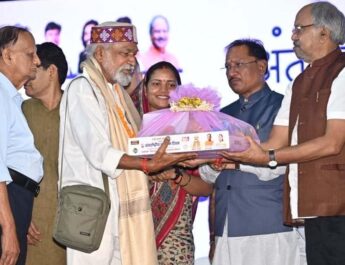
The key attraction of the celebrations was the Fifth Mahatma Gandhi Memorial Lecture, titled “Freedom after Freedom: Gandhi, the Constitution and the Unfinished Republic,” delivered by Prof. (Dr.) Paramjit Jaswal, Distinguished Jurist Professor at HNLU and former Vice Chancellor.
Addressing the gathering, Prof. Vivekanandan highlighted the continuing relevance of Mahatma Gandhi for the younger generation. He said Gandhi’s values of ethical courage, compassion, self-discipline, truthfulness, inclusivity and respect for human dignity remain important in areas ranging from artificial intelligence and public policy to law, business and democratic participation.
He said the true tribute to Gandhi lies not merely in remembering him but in confronting the questions he left behind, noting that while India’s freedom struggle had ended, the effort to build a just, compassionate, sustainable and inclusive society continues.
Democracy as a continuing journey
Delivering the memorial lecture, Prof. Jaswal reflected on the meaning of freedom and democratic responsibility. He observed that every generation inherits both freedoms that have already been won and freedoms that still need to be achieved.
Drawing upon Gandhi’s experience of racial discrimination in South Africa, Prof. Jaswal explained the concept of “E + R = O” (Event + Reaction = Outcome), stressing that while individuals may not always control events, their thoughtful and principled responses can determine outcomes.
He said Gandhi transformed personal discrimination into a wider movement for social change through the principles of truth and non-violence.
Prof. Jaswal emphasised that national progress cannot be judged solely by economic growth, infrastructure or material prosperity. The strength of a nation, he said, must also be assessed through the rule of law, dignity of citizens and the overall well-being of society.
He described political independence as only the beginning of India’s larger civilisational journey and highlighted Gandhi’s vision of Swaraj, ethical governance, dignity of labour, communal harmony, environmental responsibility and education aimed at developing the “head, heart and hands”.
While the Constitution provides the institutional framework of the Republic, he said Gandhian philosophy continues to serve as its moral compass, reinforcing the values of justice, liberty, equality and fraternity.
Referring to contemporary challenges including inequality, caste and gender discrimination, environmental degradation, artificial intelligence, misinformation, cybersecurity, data privacy and social polarisation, Prof. Jaswal cautioned that technological progress does not automatically make society wiser or more ethical.
“Technological advancement has made humanity more connected; it has not automatically made humanity wiser,” he observed.
Concluding his lecture, Prof. Jaswal said, “The Republic remains unfinished not because it has failed, but because democracy is always a work in progress.” He called upon students and future leaders to work towards building an India that is not merely successful and powerful, but also just, compassionate and morally enlightened.
Academic publications released
The occasion also witnessed the release of Volume XI, Issue I of the HNLU Journal of Law & Social Sciences (JLSS)and the edited volume Navigating the Future: AI, Metaverse & IP Conundrum, edited by Prof. V.C. Vivekanandan and Dr. Ankit Singh.
Copies of the Constitution of India were distributed among first-year students of the B.A. LL.B. (Hons.) and LL.M. programmes as part of the University’s efforts to promote constitutional literacy and responsible citizenship among future legal professionals.
Student leadership and new learning spaces
The newly constituted Student Bar Council also held its oath-taking ceremony. Mr. Vedant Rathi and Ms. Vimla Choudhary took oath as President and Vice-President respectively, along with the elected Convenors and Vice-Convenors.
Earlier, Prof. Jaswal and Prof. Vivekanandan, along with faculty, staff and students, inaugurated the redesigned Learners’ Lounge I and new group discussion facilities—The Hive & The Hub, and The Conclave & Colloquium—in Learners’ Lounge II. The upgraded spaces are aimed at encouraging collaborative learning, academic interaction and intellectual discourse.
The programme began with a welcome address by Dr. Deepak Kumar Srivastava, Registrar (I/c), HNLU, while Dr. Y. Papa Rao, Associate Professor, delivered the vote of thanks. The Student Bar Council oath-taking ceremony was coordinated by Dr. Avinash Samal, Dean of Student Welfare, and the proceedings were anchored by HNLU third-year student Ms. Anushka Bhardwaj.
Instituted in 2022, the Mahatma Gandhi Memorial Lecture Series has evolved into an annual platform for discussions on ethical leadership, enlightened governance, constitutional values and the responsibilities of citizens in a democratic society.