
Over 15,000 teachers redeployed, 5,000 teaching posts under recruitment; focus on multilingual education, digital monitoring, infrastructure and tribal education
TFP Bureau, Raipur, August 21, 2026: The Chhattisgarh School Education Department has undertaken a series of reforms over the past two years aimed at making the state’s education system more quality-oriented, transparent, technology-enabled, inclusive and student-centric.
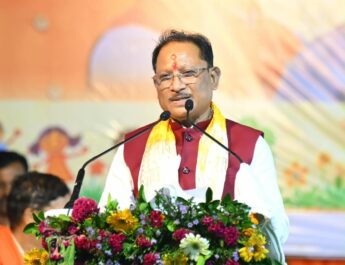
School Education Minister Gajendra Yadav and Secretary Dr Kamalpreet Singh outlined the department’s achievements and ongoing initiatives at a press conference held at the Chhattisgarh Samvad Auditorium in Atal Nagar, Nava Raipur, on Friday.
The initiatives cover teacher rationalisation and recruitment, school infrastructure, multilingual education, digital monitoring, student welfare, examination performance and expansion of educational facilities in tribal and remote areas.
10,538 schools rationalised, over 15,000 teachers redeployed
In line with the National Education Policy (NEP) 2020 and the Right to Education Act, 10,538 schools have been merged or adjusted. The rationalisation exercise resulted in the redeployment of 15,165 teachers and principals.
According to the department, 453 schools that previously lacked teachers have been provided teaching staff, while staffing arrangements have been made for 4,729 single-teacher schools.
The department has also recorded more than 7,000 promotions across various posts during the last two years, including 2,813 principal promotions and 1,798 lecturer promotions in the T cadre.
Recruitment of teachers gains momentum
The government has sanctioned 848 posts for special educators for children with disabilities, while 62 appointments were made through direct recruitment in 2025.
Direct recruitment has also been completed for 2,104 academic posts during the last two years. Recruitment for another 5,000 teaching posts is currently underway, while contractual recruitment for more than 3,000 posts in Swami Atmanand and Swami Vivekananda schools is in progress.
Computer-based recruitment to enhance transparency
The department has introduced a state-level online Computer-Based Test (CBT) system for recruitment of academic and non-academic contractual staff in Swami Atmanand Utkrisht Vidyalayas, Swami Vivekananda Utkrisht Vidyalayas and other government institutions.
The current recruitment process covers 3,066 contractual posts—1,895 in Swami Atmanand Utkrisht Vidyalayas and 1,171 in Swami Vivekananda Utkrisht Vidyalayas. The system is intended to improve transparency and facilitate faster declaration of examination results.
Multilingual education receives special focus
NEP 2020 was implemented in schools from July 15, 2024. The state has incorporated the Barakhadi into Hindi textbooks for Classes 1 and 2, while textbooks have been developed in 16 local and four inter-state languages.
Chhattisgarh has also undertaken language mapping, described by the department as the first such exercise in the country. As part of the initiative, 2,700 teachers in Bastar division and 2,368 teachers in Surguja division have received training to use children’s native languages in classrooms.
Textbooks in Chhattisgarhi, Gondi, Halbi and Sadri are also being developed as mediums of instruction for Classes 1 to 3.
Digital technology strengthens monitoring
The department has introduced Aadhaar-based biometric attendance and the ‘Tike’ app to monitor teacher attendance. Around 85 per cent of teachers are recording their attendance daily through the application.
Administrative processes have also been digitised through a leave management portal, paperless workflows and online asset declarations.
An AI-based Vidya Samiksha Kendra has been established to monitor education schemes, infrastructure, physical facilities and PM Poshan activities. More than one lakh calls have been made through the centre to obtain feedback from teachers, parents, cluster coordinators and officials.
Barcode-based tracking of textbook distribution has also reportedly resulted in savings of around ₹40 crore.
Free textbooks, bicycles and uniforms provided
The department said 45.33 lakh students from Classes 1 to 10 benefited from the distribution of textbooks before the beginning of the academic session.
Under the Saraswati Cycle Yojana, 1.62 lakh girl students received bicycles, while 28.63 lakh students in Classes 1 to 8 benefited from free uniforms.
Examination results show improvement
The department reported an improvement of around two percentage points in the Class 10 and Class 12 examination results during the 2025-26 academic session.
Pre-examination reviews, preparation of examination blueprints, teaching strategies and parent-teacher meetings have been among the measures adopted to improve academic performance.
‘Bag-free Saturdays’ promote holistic development
The department is implementing ‘Bag-free Saturdays’ to provide students with a stress-free learning environment. Activities include sports, yoga, physical exercise, local art and culture, essays, speeches, songs, stories and folk traditions.
The initiative is aimed at encouraging students’ academic, cultural, physical and creative development beyond conventional classroom learning.
₹100 crore allocated for 150 Schools of Excellence
The state has made a budgetary provision of ₹100 crore for the construction and operation of 150 Swami Vivekananda Utkrisht Vidyalayas during 2026-27.
The government aims to establish at least one such school in every development block, with an emphasis on preparing students for future educational and professional challenges.
School infrastructure receives major push
A total of 504 new schools have been sanctioned over the past three years, while provisions have been made in the 2026-27 Budget for new buildings for 700 schools that currently lack adequate infrastructure.
Between 2023 and 2026, approval was granted for the construction of 2,583 additional classrooms. The government has also sanctioned ₹52.39 crore for construction and repair of school toilets, with 302 toilets already completed.
Focus on education in Bastar and tribal regions
The department has expanded educational facilities in Bastar under the Niyat Nella Nar initiative. Primary schools have been established in 97 per cent of villages across the six districts of the Bastar division.
As many as 13,817 teachers in the division have been trained in the use of bilingual textbooks. In schools with no teachers or only one teacher, education is being supported by 573 Shiksha Doots.
The department has also reopened 48 closed schools and established 36 new schools.
Residential facilities expanded for PVTG children
Under the Pradhan Mantri Janman Yojana, residential hostel facilities are being developed near schools for children belonging to Particularly Vulnerable Tribal Groups (PVTGs).
More than 33,000 children are currently benefiting from residential facilities in 156 schools and hostels across the state. Forty PVTG hostels have been sanctioned in 13 districts, with construction underway at 21 locations.
Under the Pradhan Mantri Dharti Aaba Tribal Village Upliftment Campaign, approval has also been granted for 42 hostels across 13 districts.
Education system moving towards greater inclusivity
The School Education Department said its ongoing reforms are aimed at ensuring equal access to quality education for students across Chhattisgarh.
With emphasis on teacher availability, transparent recruitment, modern infrastructure, multilingual learning, digital monitoring, student welfare and educational access in tribal and remote areas, the government is seeking to build an education system that is quality-driven, transparent, technology-enabled and centred on the needs and holistic development of students.