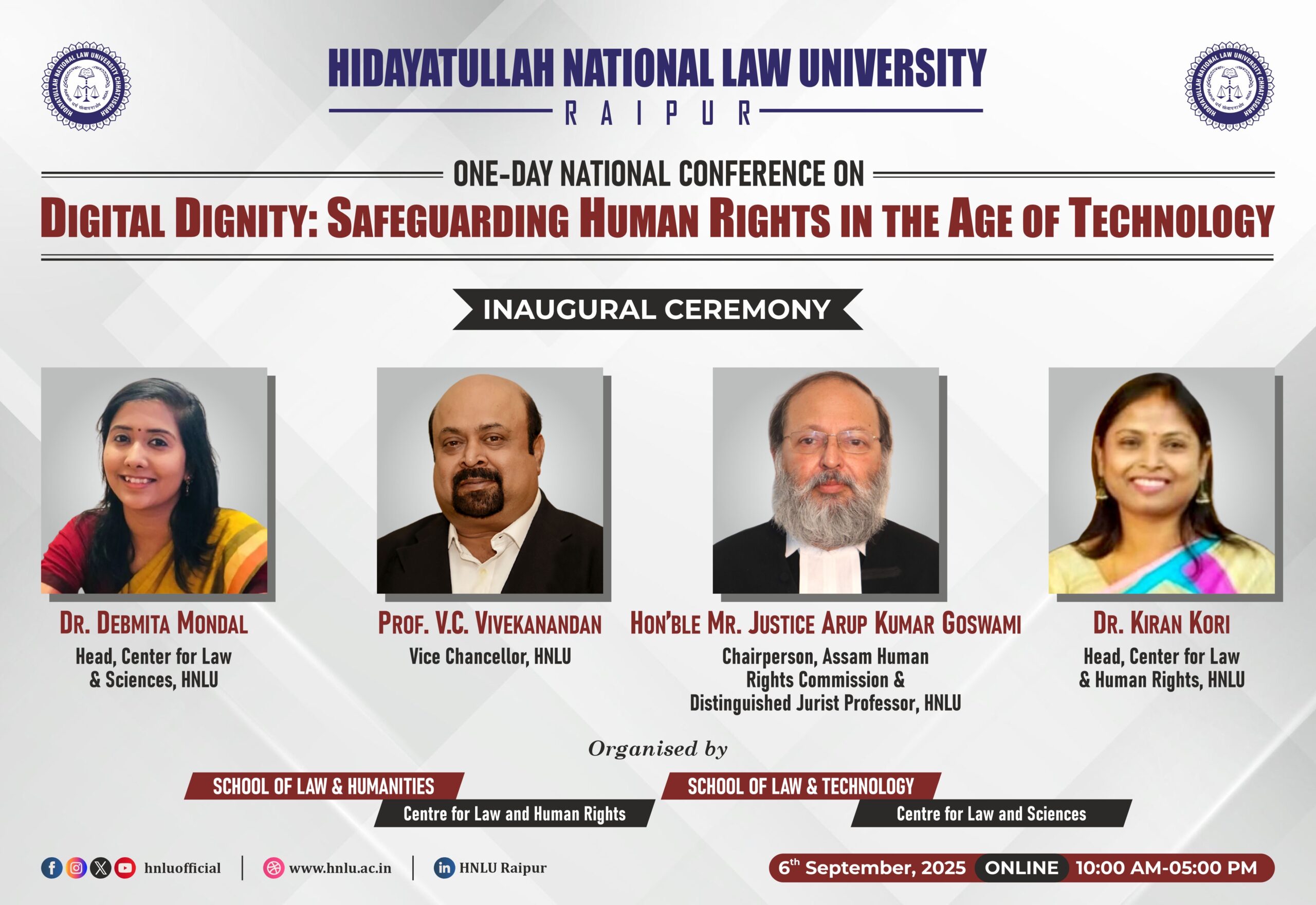
TFP Bureau, Raipur, September 8, 2025: Hidayatullah National Law University (HNLU), Raipur, through its Centre for Law & Human Rights and Centre for Law and Science, hosted a One Day Online National Conference on the theme “Digital Dignity: Safeguarding Human Rights in the Age of Technology.” The event brought together eminent jurists, academicians, researchers, and students from across the country to deliberate on how constitutional values and human rights can be protected in the midst of rapid technological transformation.
The conference drew an overwhelming response, with nearly 150 abstract submissions, out of which 60 were selected for presentation. Participants from premier law schools, universities, and research institutions presented their work across eight parallel technical sessions. Discussions centered around pressing issues such as data privacy, algorithmic bias, digital wellbeing, surveillance, misinformation, and secure communications, highlighting the multidisciplinary challenges of protecting human rights in the digital age.
The inaugural session was graced by Hon’ble Justice Arup Kumar Goswami, Chairperson of the Assam Human Rights Commission, former Chief Justice of the High Court of Chhattisgarh, and former Chancellor of HNLU. In his keynote address, Justice Goswami emphasized that human dignity remains the cornerstone of rights jurisprudence since its recognition in the Universal Declaration of Human Rights, 1948. He stressed the urgent need to safeguard dignity in an era where technology permeates every aspect of life. Complimenting HNLU for taking up this timely theme, he called the conference a roadmap for the future of human rights and technology.
HNLU Vice Chancellor Prof. (Dr.) V.C. Vivekanandan, in his opening remarks, highlighted the importance of “rights-based technology design, judicial innovation, and international cooperation” in shaping future human rights discourse. Registrar Dr. Deepak Kumar Shrivastava welcomed participants, while Dr. Debmita Mondal, Head of the Centre for Law and Science, outlined the objectives and sub-themes of the conference. Dr. Kiran Kori, Head of the Centre for Human Rights, proposed the vote of thanks.
The valedictory session featured Prof. Paramjit Singh Jaswal, Vice Chancellor of SRM University, Sonepat, and Distinguished Jurist Professor of HNLU, who analyzed landmark judgments including Justice K.S. Puttaswamy vs Union of India (privacy case) and Shreya Singhal vs Union of India (free speech case). He identified seven key parameters to evaluate the human rights–technology interface and underscored that constitutional values and human rights are non-negotiable in any technological era.
Prof. Vivekanandan, in his concluding remarks, reiterated that while technology has historically been a disruptor, the law must continue to serve as a stabilizer. He cautioned that unchecked technological opacity and lack of accountability could undermine decades of progress in human rights protections.
Student coordinators Mahika Gupta, Samridhi Dubey, Anuska Sharma, Dimpal Khatri, and Aayushka Pandey anchored various sessions of the day, while Dr. Debmita Mondal and Dr. Kiran Kori presented detailed reports on the proceedings.
The conference concluded with a strong message: in the digital era, protecting human rights requires proactive legal frameworks, technological accountability, and unwavering adherence to constitutional values. It underscored the urgent need for academia, judiciary, and policymakers to collaborate in ensuring that technology enhances rather than erodes human dignity.