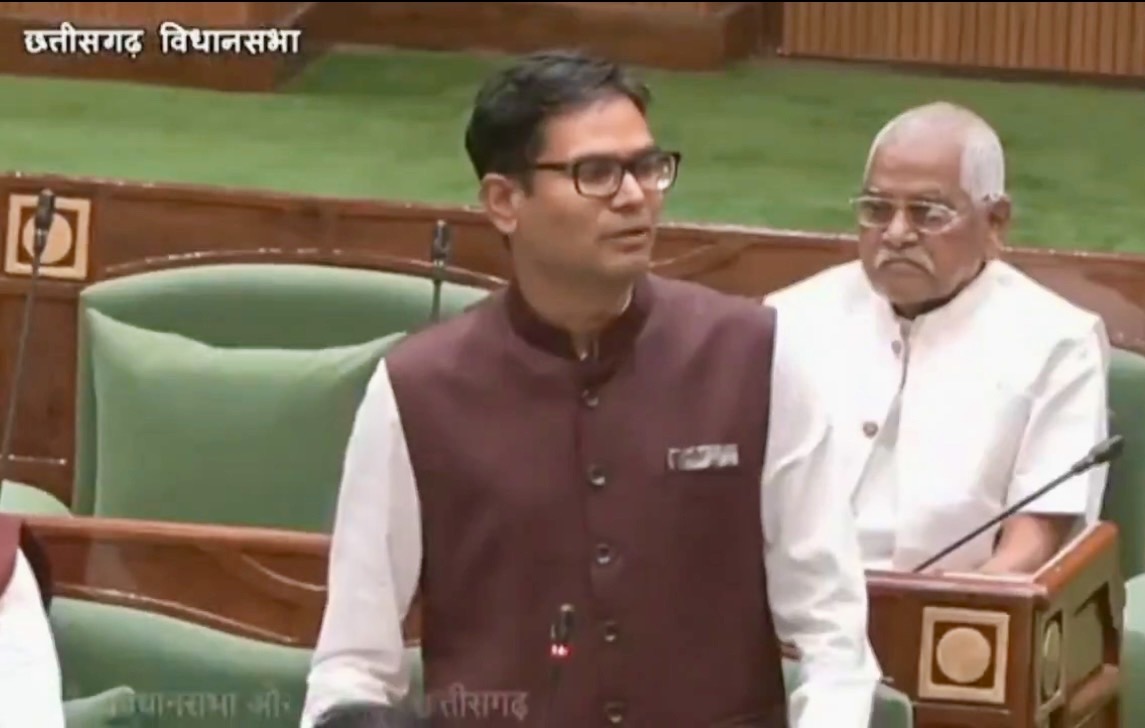
TFP Bureau, Raipur, December 16, 2025: The Chhattisgarh government on Tuesday presented the largest supplementary budget in the state’s history, amounting to ₹35,000 crore, underlining a strong commitment to development, fiscal discipline and long-term economic stability. Finance Minister Shri O.P. Choudhary said the supplementary budget goes beyond routine financial allocations and lays a solid foundation for sustained growth, institutional strengthening and inclusive development.
Addressing the media, the Finance Minister said the state had inherited liabilities exceeding ₹45,000 crore across boards and corporations from the previous government, pushing several key institutions into financial distress. He said the present government has taken decisive steps to revive and stabilise critical bodies such as MARKFED and NAAN, which form the backbone of paddy procurement and the public distribution system. “Without strengthening these institutions, farmer welfare and food security cannot be ensured,” he said.
A major thrust of the supplementary budget is capital expenditure, which the government has identified as the cornerstone of future economic prosperity. Shri Choudhary noted that while revenue expenditure addresses immediate needs, capital investment in roads, irrigation, power, health, education and digital connectivity creates durable assets that drive growth for decades. Reflecting this approach, capital expenditure in Chhattisgarh has increased nearly 55 times since the state’s formation 25 years ago.
Capital outlay stood at ₹13,320 crore in 2022–23, rose to ₹15,419 crore in 2023–24 and further to ₹20,055 crore in 2024–25. In the 2025–26 main budget, ₹26,341 crore has been earmarked for capital expenditure, with an additional ₹2,000 crore provided through the supplementary budget. Capital expenditure as a proportion of the total budget is projected to rise to 4.1 per cent in 2025–26, compared to about 3.5 per cent earlier, signalling a clear shift towards long-term infrastructure creation.
The supplementary budget accords high priority to road and transport infrastructure. An allocation of ₹175 crore has been made for Rural Roads Programme Phase-2 to strengthen village connectivity, while ₹150 crore has been provided under the Chhattisgarh State Road Sector Project (ADB Loan-3) for upgrading major roads. The regional rail network will also receive a boost with ₹86 crore allocated for the Chirmiri–Nagpur Halt rail line project.
Agriculture and farmer welfare feature prominently in the budget. A provision of ₹2,000 crore has been made under the Agricultural Development Scheme to modernise farming and enhance farmers’ incomes. To reduce irrigation costs, ₹1,700 crore has been allocated to provide free electricity for agricultural pumps up to 5 HP. Interest-free loan support has been strengthened with a provision of ₹187 crore, while ₹122 crore has been earmarked for the Pradhan Mantri Fasal Bima Yojana and ₹35 crore for the Pradhan Mantri Krishi Sinchai Yojana. A biotech incubation centre, with an allocation of ₹4 crore, aims to promote agricultural innovation and research.
Food security and nutrition systems have received substantial support, with ₹19,224 crore provided to clear pending liabilities and stabilise the public distribution system. This includes ₹6,800 crore under the Chief Minister’s Foodgrain Assistance Scheme. In addition, ₹12,424 crore has been allocated to offset losses incurred by MARKFED in paddy procurement, ensuring timely payments to farmers and long-term stability of the food security framework.
Industrial development has been supported with a total allocation of ₹360 crore. This includes ₹180 crore for developing new industrial areas, ₹130 crore as capital subsidy to encourage investment, and ₹25 crore as interest subsidy to enhance industrial competitiveness. These measures are expected to spur investment, job creation and balanced industrial growth.
The budget also places emphasis on women empowerment, rural development and social welfare. An allocation of ₹2,500 crore has been made for the Mahtari Vandan Yojana to ensure financial security and dignity for women. Nutrition and child development will be strengthened through ₹225 crore under Saksham Anganwadi and Poshan 2.0. Rural housing has received an additional ₹1,000 crore over and above the ₹8,500 crore provided in the main budget, while rural infrastructure will be bolstered through allocations under PMGSY, Swachh Bharat Mission, National Rural Livelihoods Mission and National Gram Swaraj Abhiyan.
Significant provisions have also been made for road safety and environmental protection. These include ₹154 crore for fire and emergency vehicles across districts, ₹75 crore for ANPR camera systems to improve traffic discipline, ₹12 crore for automated driving test tracks, and ₹35 crore as subsidy to promote electric vehicles.
The Finance Minister highlighted that over ₹25,000 crore has been directly transferred to farmers in the past two years, reflecting the government’s farmer-centric approach. He also said the state is making steady progress towards eliminating Left-Wing Extremism by March 2026 through a combined strategy of development, dialogue and security. Regions like Bastar, he noted, are witnessing a positive transformation through cultural and sporting initiatives alongside infrastructure development.
Chief Minister Shri Vishnu Deo Sai described the ₹35,000-crore supplementary budget as a historic step that balances fiscal discipline with inclusive growth. He said the budget creates equal opportunities for farmers, women, youth, the poor and industries, and firmly positions Chhattisgarh on the path towards becoming one of the country’s leading developed states.