
International conference hosted by Election Commission of India charts roadmap for electoral integrity, technology use and capacity building; next meet proposed in December 2026
TFP Bureau, Raipur, January 24, 2026:
The three-day India International Conference on Democracy and Election Management (IICDEM) 2026 concluded at Bharat Mandapam, New Delhi, with the unanimous adoption of the ‘Delhi Declaration 2026’, marking a significant step towards strengthening global cooperation among Election Management Bodies (EMBs). The declaration lays down a comprehensive five-pillar framework aimed at enhancing the credibility, transparency and professionalism of election administration worldwide.
The closing session was attended by Chief Election Commissioner of India Shri Gyanesh Kumar, Election Commissioners Dr. Sukhbir Singh Sandhu and Dr. Vivek Joshi, heads of Election Management Bodies from 42 countries, experts from over 70 national institutions, senior officials of the Election Commission of India, and 36 Chief Electoral Officers from States and Union Territories.
Delhi Declaration Read Out, Adopted Unanimously
During the valedictory session, Chief Election Commissioner Shri Gyanesh Kumar formally read out the Delhi Declaration 2026, which was unanimously adopted by all participating EMBs. Through the declaration, the global electoral community resolved to work collectively on five key pillars—accuracy of electoral rolls, conduct of elections, research and publications, use of technology, and training and capacity building.
The participants also agreed to periodically review progress on these commitments and proposed to reconvene for a follow-up meeting on December 3, 4 and 5, 2026, at the India International Institute of Democracy and Election Management (IIIDEM), New Delhi.
Key Decisions on Knowledge Sharing and Collaboration
As part of the declaration, EMBs resolved to jointly bring out a co-curated ‘Encyclopaedia of Democracies of the World’, including an ‘Atlas’ detailing how electoral systems function across countries, duly approved by the respective EMBs. In addition, comprehensive reports on seven thematic areas will be prepared under the leadership of International IDEA, while IIIDEM will lead the preparation of detailed reports on 36 themes.
The conference also agreed on the co-development of a digital platform on the lines of ECINET, the Election Commission of India’s integrated digital system. EMBs expressed interest in adapting similar platforms as per their legal frameworks and local languages. Further, the exchange of training modules and transparent practices through IIIDEM was endorsed to promote professionalism in election conduct and electoral roll preparation.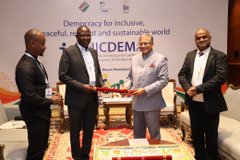
Leaders Emphasise Trust, Technology and Cooperation
In his keynote address, Chief Election Commissioner Shri Gyanesh Kumar said the conference had triggered meaningful discussions on evolving model international electoral standards. Referring to over 40 bilateral meetings held during the event, he noted that these interactions significantly expanded mutual cooperation and helped align collective priorities and perspectives among EMBs.
Election Commissioner Dr. Sukhbir Singh Sandhu highlighted that openness, mutual respect and the willingness to learn from each other reflect the growing maturity and professionalism of the global electoral community.
Election Commissioner Dr. Vivek Joshi underlined the importance of technology in modern election management, describing the launch of ECINET as a milestone in India’s technological journey. He said the platform reinforces the principle that technology must support trust in elections, not replace it.
Conference Highlights and Participation
IICDEM 2026, described as the first-of-its-kind and the largest conference of its nature, began with a grand inaugural session attended by nearly 1,000 participants. These included international representatives from 42 Election Management Bodies and Heads of Mission from 27 countries.
A key feature of the conference was the ‘EMB Leaders’ Plenary’, where heads of delegations and ambassadors and high commissioners engaged in high-level deliberations on democracy and election management. On the second day, ECINET was formally launched as the Election Commission of India’s one-stop digital platform for election-related information and services.
Throughout the conference, 36 thematic groups led by Chief Electoral Officers of States and Union Territories, in collaboration with leading academic institutions and subject experts, held in-depth discussions on global electoral challenges, innovations, and best practices.
Five Pillars of the Delhi Declaration 2026
The declaration reaffirmed that an accurate and inclusive electoral roll forms the foundation of democracy, and EMBs should strive to issue photo identity cards to all eligible voters. It emphasised participatory, inclusive and impartial conduct of elections, adherence to constitutional mandates, and transparent functioning of EMBs.
On technology, the declaration stressed adopting modern tools while safeguarding electoral integrity and countering misinformation. In training and capacity building, India offered to share its extensive experience through IIIDEM, which has trained over 10,000 election officials from India and more than 100 countries over the past 15 years.
Way Forward
Concluding the conference, participants resolved to implement the Delhi Declaration through collaboration, innovation and measurable actions. The annual review mechanism and the proposed December 2026 meeting at IIIDEM are expected to further institutionalise global cooperation in election management.
Adopted in New Delhi on January 23, 2026, the Delhi Declaration 2026 is being seen as a landmark outcome of IICDEM, reinforcing India’s role as a global leader in democratic and electoral practices.