Senior journalists, litterateurs and travel writers reflect on the evolving relationship between creative expression, public discourse and cultural exploration at Raipur Sahitya Utsav
TFP Bureau, Raipur, January 25, 2026: The third and concluding day of the Raipur Sahitya Utsav witnessed a rich exchange of ideas through two engaging panel discussions that explored the deep connections between journalism and literature, as well as the growing influence of travel writing and blogging in shaping cultural awareness. Both sessions were held at the Lala Jagdalpuri Mandap and drew an attentive audience of writers, students, readers and cultural enthusiasts.
Journalism and Literature: Two Streams, One Social Purpose
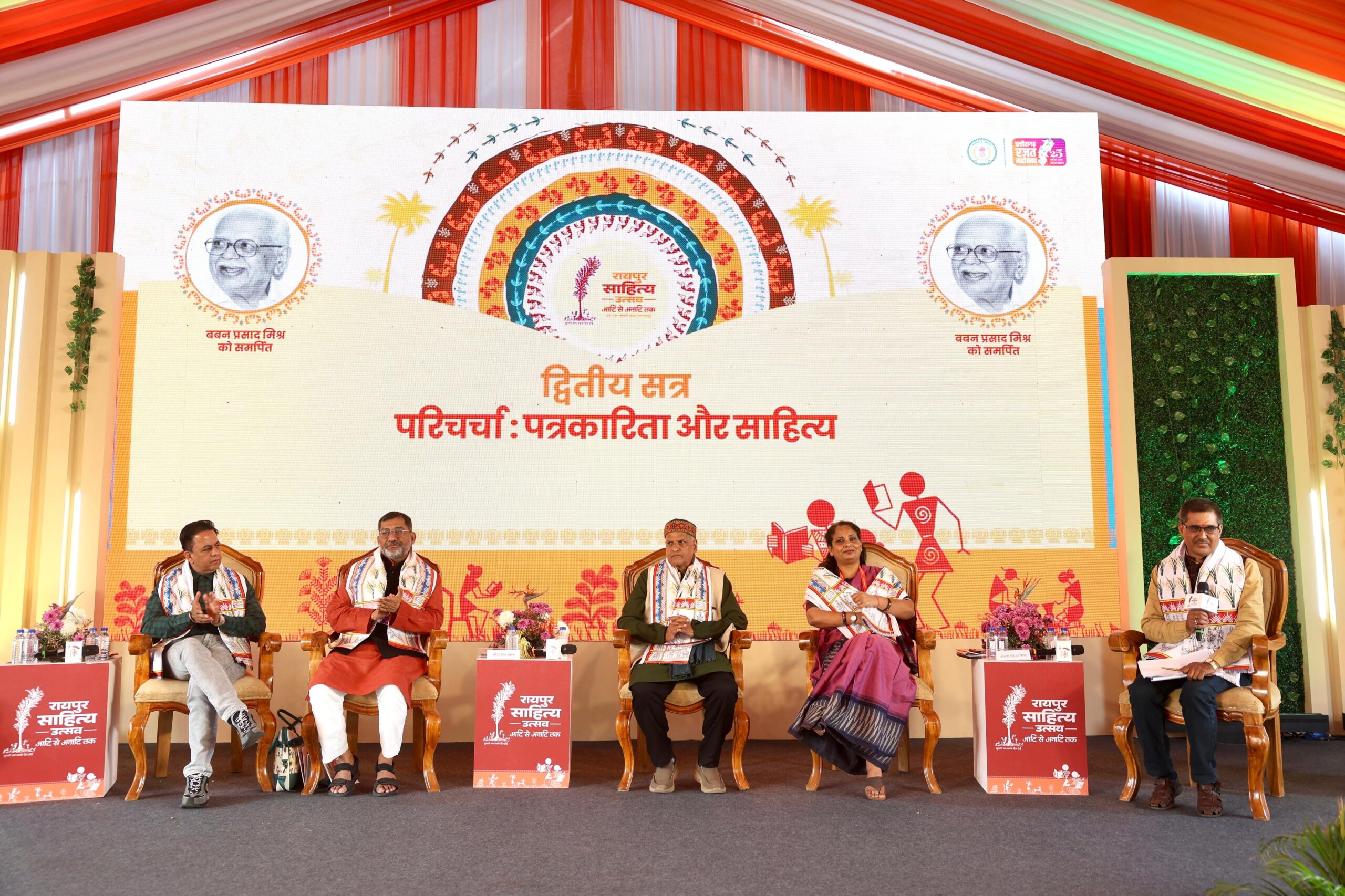
The second session of the day featured a panel discussion titled “Patrakarita Aur Sahitya”, dedicated to the memory of late Shri Baban Prasad Mishra. The panel comprised senior journalists and litterateurs Ms Smita Mishra, Dr Himanshu Dwivedi, Shri Awdhesh Kumar and Shri Girish Pankaj, with the session being moderated by senior journalist Shri Vibhash Jha.
Sharing his views, Shri Girish Pankaj emphasised that both journalism and literature must remain firmly rooted in public interest and social responsibility. He noted that writing, irrespective of its form, carries a moral obligation to highlight social realities and contribute meaningfully to public discourse.
Chief Editor of Haribhoomi, Dr Himanshu Dwivedi observed that objectivity, factual accuracy and sensitivity form the backbone of journalism, while literature allows for deeper reflection on events and circumstances. Drawing a distinction between the two, he explained that journalists often work within organisational frameworks, editorial policies and professional constraints, whereas litterateurs enjoy greater creative freedom to explore multiple layers of a subject.
Ms Smita Mishra pointed out that the primary difference between journalism and literature lies in style, language and narrative approach. While journalism focuses on facts and immediacy, literature delves into emotions, sentiments and long-term social impact. However, she stressed that empathy, sensitivity in language and a broader perspective are equally essential to both disciplines, as each has the power to influence collective thought and social consciousness.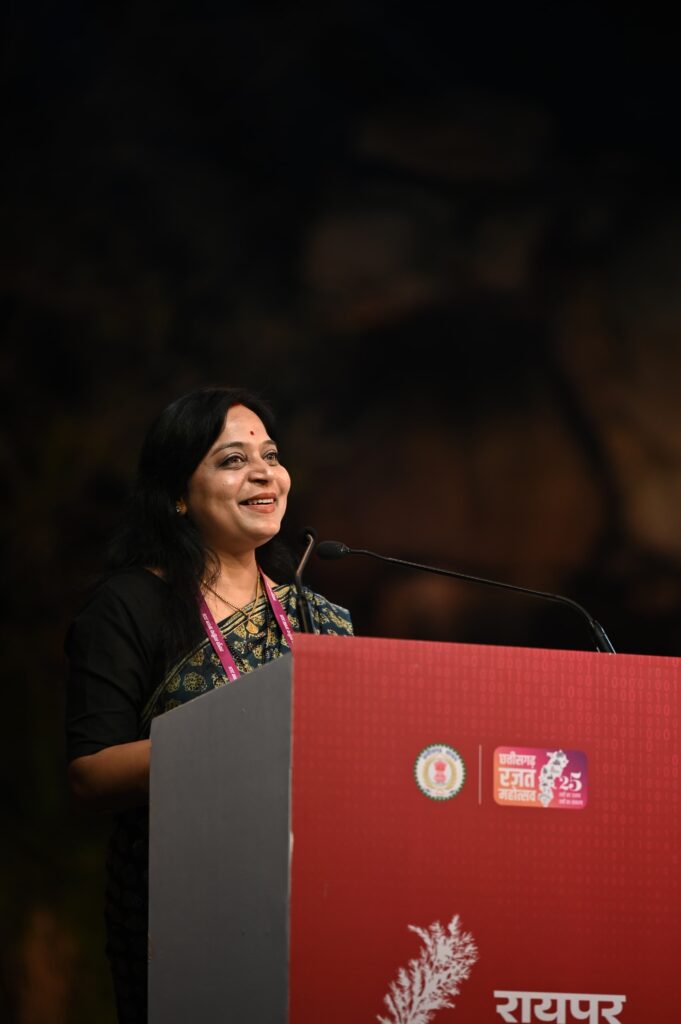
Sharing insights from his dual role as a journalist and a writer, Shri Awdhesh Kumar described journalism and literature as two sides of the same coin. He explained that many of his literary works have been inspired by human-interest stories encountered during his journalistic career, allowing him to explore their deeper human and social dimensions through creative writing.
Moderator Shri Vibhash Jha recalled the legacy of eminent journalists from Chhattisgarh, including Shri Gajanan Madhav Muktibodh and Shri Madhav Rao Sapre, who effectively used literature as a medium to expand social awareness. The panel also discussed the growing influence of social media, highlighting both its potential and the challenges it poses to responsible journalism in the digital age.
On the occasion, two poetry collections—“Karun Prakash” by Ms Smriti Dubey and “Yah Basuri Ki Nahi Bela Hai”by Shri Loknath Sahu Lalkar—were formally released by the dignitaries, adding a literary highlight to the session.
Travel Writing as a Catalyst for Cultural Awareness
Earlier in the day, the first session titled “Travel Blog: Paryatan Ke Prerak” focused on the role of travel writing in inspiring tourism, cultural understanding and personal growth. The session featured renowned travel journalist, blogger and solo traveller Ms Kaynat Kazi, and author Ms Shikha Varshney, best known for her book “Desi Chashme Se London Diary.” The discussion was moderated by Shri Rahul Choudhary.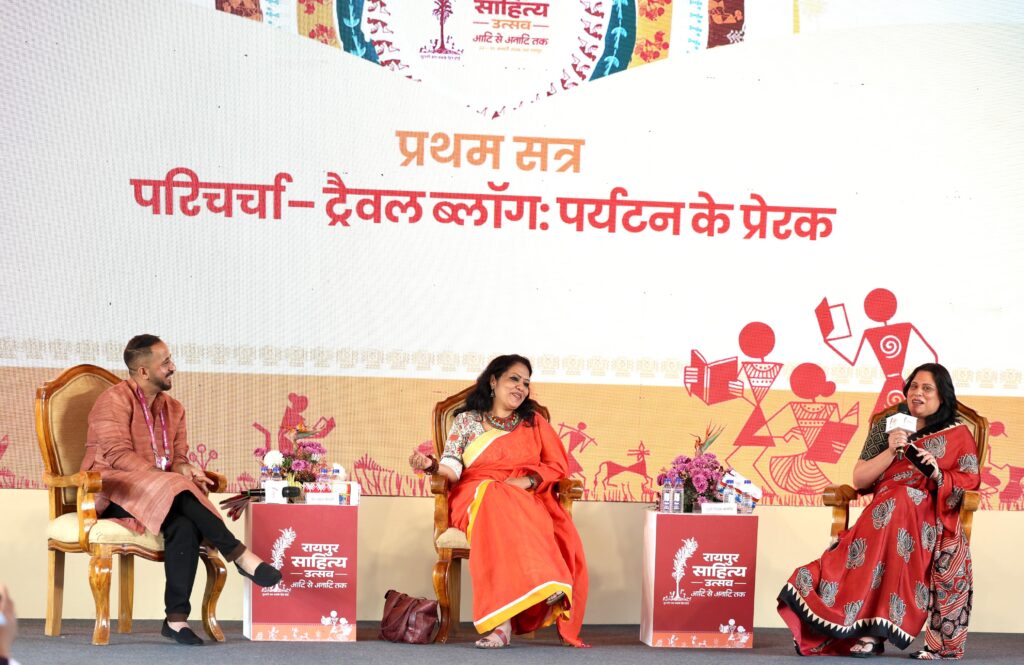
Speaking about her journey, Ms Kaynat Kazi said that Hindi literature had played a crucial role in shaping her worldview and inspiring her to travel. She noted that while her travels across India motivated her to blog and document experiences, her primary purpose remained exploration and learning rather than popularity. Emphasising the idea of conscious travel, she urged travellers to fully immerse themselves in local cultures, traditions and environments. She added that travel blogging serves as a powerful tool to document first-hand experiences of destinations, cultures and events.
Ms Shikha Varshney shared that curiosity had been the driving force behind her travels and writing. She recalled that her education in a government school introduced her to Hindi literature, which enriched her vocabulary and expressive abilities. Although she spent only 14–15 years living in India, extensive travel across the country with her father exposed her to the country’s diverse cultural landscape.
Reflecting on global travel experiences, Ms Varshney remarked that Indians often underestimate the tourism potential of their own country. “India has a rich historical lineage and a vibrant cultural heritage reflected in its customs, traditions, monuments and archaeological sites. We must not only take pride in this legacy but also make sincere efforts to experience it first-hand,” she said.
Moderator Shri Rahul Choudhary shared insights from his own travels and highlighted the importance of keen observation in travel writing. He particularly emphasised that Chhattisgarh, especially the Bastar region, deserves a prominent place on every traveller’s itinerary due to its natural beauty, rich folk traditions and lush green landscapes.
Addressing the younger generation, the panelists expressed concern over declining reading habits and the resulting limitations in vocabulary and expression. They encouraged young readers to engage more deeply with literature and advised writers to adopt language and styles that are more accessible and relatable to youth.
The concluding sessions of the Raipur Literature Festival underlined the enduring relevance of literature, journalism and travel writing in fostering awareness, empathy and cultural pride, leaving the audience with renewed inspiration to read, write and explore.