
World leaders and technology chiefs call for inclusive, ethical and sovereign AI as India positions itself at the heart of the global AI governance debate
TFP Bureau, New Delhi, February 19: The India AI Impact Summit 2026 marked a defining moment in the global discourse on artificial intelligence, as world leaders, heads of multilateral institutions and chief executives of leading technology companies converged in the national capital to back innovation anchored in responsibility, inclusion and shared prosperity.
The high-level opening ceremony of the summit, held at Bharat Mandapam, was inaugurated by Prime Minister Narendra Modi and set the tone for deliberations on how artificial intelligence can be harnessed as a force for public good while managing its disruptive potential. Speakers repeatedly stressed that the future of AI must not deepen global inequalities or concentrate power in the hands of a few nations or corporations.
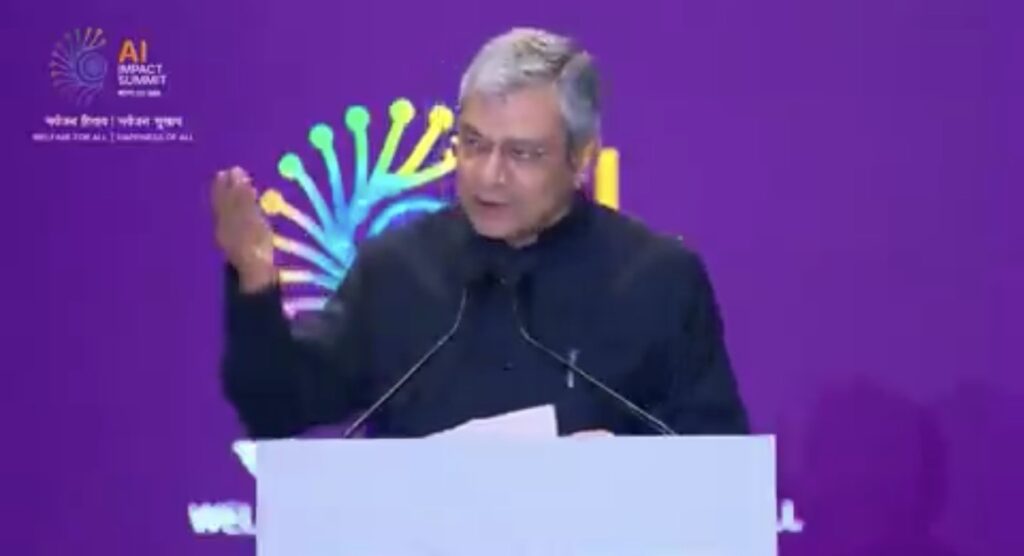
Addressing the gathering, Union Minister for Electronics and Information Technology Ashwini Vaishnaw outlined India’s AI vision as one rooted in democratisation, scale and technological sovereignty. He explained that India is pursuing a comprehensive strategy across all five layers of the AI stack—applications, models, compute infrastructure, talent and energy—while ensuring real-world deployment in priority sectors such as healthcare, agriculture, education and citizen-centric public services. According to him, India’s approach seeks to combine innovation with affordability and accessibility, ensuring that AI solutions reach the grassroots.
Industry leaders echoed the government’s emphasis on inclusion. N. Chandrasekaran, Chairman of Tata Sons, described artificial intelligence as the next foundational infrastructure, comparable in impact to the steam engine, electricity and the internet. Calling AI “the infrastructure of intelligence”, he highlighted India’s success in building digital public infrastructure and argued that AI must similarly be developed as a national capability across the full technology stack—from chips and systems to energy and applications. He stressed that the true measure of success would be placing AI tools “in the hands of the last person of the country”, warning that trust, stewardship and human capability would become the scarcest resources in an age of abundant intelligence.
Offering a note of caution amid optimism, Dario Amodei, Chief Executive Officer of Anthropic, drew attention to the extraordinary pace of AI development over the past decade. Reflecting on the period since the first global AI Safety Summit at Bletchley Park in 2023, he said progress had been “staggering” and warned that AI systems may soon surpass human cognitive capabilities across most domains. While underlining the immense opportunities—ranging from curing diseases to lifting billions out of poverty—he cautioned that such rapid advancement also brings serious risks. He called for close cooperation between governments and companies to manage disruption and ensure that the gains from AI-driven productivity are shared widely and responsibly.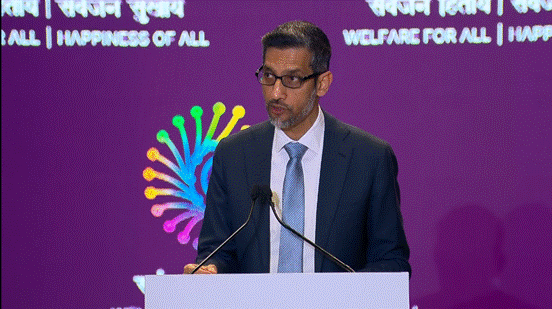
The theme of equitable access was reinforced by Sundar Pichai, Chief Executive Officer of Google, who described artificial intelligence as “the biggest platform shift of a lifetime”. Highlighting AI’s potential to accelerate scientific discovery and enable emerging economies to leapfrog legacy gaps, he warned that positive outcomes are not automatic. He stressed the need for bold yet responsible development, cautioning that the world “cannot allow the digital divide to become an AI divide”.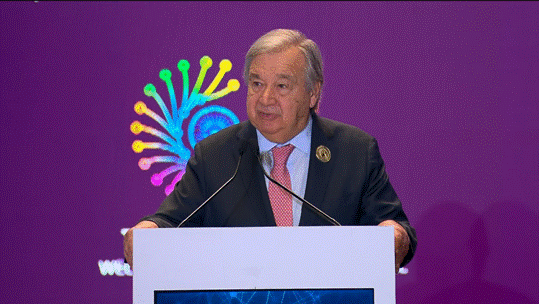
From a global governance perspective, António Guterres, Secretary-General of the United Nations, praised India for hosting the first major AI summit in the Global South. He asserted that the future of artificial intelligence must not be dictated by a handful of powerful countries or shaped solely by private commercial interests. Detailing recent steps taken by the UN General Assembly, he referred to the creation of an independent international scientific panel on AI comprising 40 global experts and the launch of a Global Dialogue on AI Governance aimed at inclusive, multi-stakeholder participation. Calling for strong guardrails, he emphasised the need to preserve human agency, oversight and accountability, and proposed the establishment of a Global Fund on AI to help developing countries build basic AI capacity.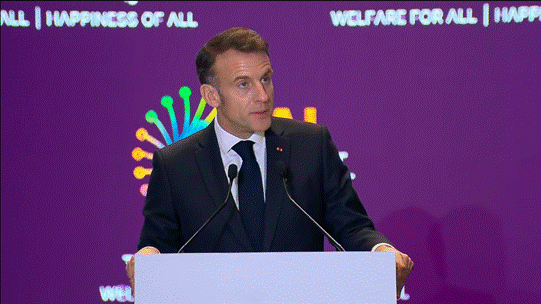
Delivering the keynote address, French President Emmanuel Macron highlighted the strategic importance of sovereign and collaborative AI development in an era of intensifying geopolitical competition. Drawing parallels between India’s digital public infrastructure revolution and the ongoing AI transformation, he described AI as a domain that will shape geopolitics, economic power and the global balance. Stressing that innovation must go hand in hand with responsibility, he said the “smartest AI is not the most expensive, but the one built by the best people for the right purpose”. He underlined that nations need not resign themselves to being mere markets for foreign technologies and data extraction, pointing to India and Europe as partners in shaping an independent and humane AI future.
The presence of global political leaders, senior policymakers, multilateral institutions and technology pioneers at the inaugural session underscored the India AI Impact Summit 2026’s emergence as a key global platform for shaping the trajectory of artificial intelligence. As discussions continue, the summit has firmly positioned India at the centre of international efforts to balance innovation with ethics, sovereignty with collaboration, and technological progress with human dignity.