
State-level launch of Atal Aarogya Lab promises free diagnostic tests across 1,046 health centres; Chief Minister dedicates and lays foundation for 228 projects worth over ₹308 crore, marking a new chapter of peace and development in Naxal-affected Bastar.
TFP Bureau, Raipur, April 13,2026: In a landmark moment for Bastar’s transformation, Chhattisgarh Chief Minister Vishnu Deo Sai on Monday launched the state-level ‘Atal Aarogya Lab’ at the District Hospital in Sukma and dedicated as well as laid the foundation stone for development projects worth over ₹308 crore, signalling what he described as a “new beginning of a health and development revolution” in the region.
The twin initiatives — strengthening healthcare infrastructure and accelerating development works — underscore the government’s renewed focus on Bastar, once deeply affected by Naxal violence but now steadily moving towards peace and progress.
Free Diagnostic Facilities Across the State
Launching the ‘Atal Aarogya Lab’, the Chief Minister said the initiative draws inspiration from the Indian ethos of “Sarve Bhavantu Sukhinah, Sarve Santu Niramayah” and aims to ensure accessible and affordable healthcare for every citizen.
He announced that under the scheme, free diagnostic services will be made available at 1,046 government health institutions across the state — ranging from district hospitals to primary health centres. Citizens will have access to 133 types of diagnostic tests free of cost through a digitally integrated system.
“With the Atal Aarogya Lab, we are ensuring that quality, affordable and timely healthcare reaches even the most remote villages,” Sai said, adding that the initiative would directly benefit lakhs of people, particularly those in forested and inaccessible regions like Bastar.
Test reports will be delivered directly to patients via SMS and WhatsApp, significantly reducing the need for repeated hospital visits and expediting treatment. The Chief Minister said the digital system would enhance transparency, improve efficiency and reduce out-of-pocket expenditure for patients.
He emphasised that the strengthening of diagnostic infrastructure would enable faster and more accurate detection of diseases, including blood-related ailments, thereby improving recovery rates and overall public health outcomes.
Strengthening Healthcare in Remote Bastar
Sukma District Hospital already offers key facilities such as a blood bank, sonography, X-ray, ECG, emergency services, caesarean deliveries, a Nutrition Rehabilitation Centre (NRC), and dialysis. With the addition of the Atal Aarogya Lab, healthcare services in the district are expected to become more comprehensive and robust.
The Chief Minister noted that expanding modern healthcare facilities in regions like Bastar is a top priority, so that residents no longer have to depend on distant urban centres for quality treatment.
During the programme, Sai also underwent a health check-up under the “Mukhyamantri Swasth Bastar Abhiyan,” which aims to provide doorstep healthcare services across seven districts. Under this campaign, 1,100 teams will conduct health screenings to ensure early diagnosis and treatment.
At the Health Department stall set up at the venue, certificates were distributed to seven TB-free gram panchayats. Officials informed that 28 panchayats in Sukma district have achieved TB-free status. The Chief Minister also interacted with TB patients and distributed food baskets to support their nutritional needs.
Patients who had undergone cataract surgeries were presented with spectacles, medicines and eye drops. Sub-health centres in Murtunda, Penta and Kankerlanka were awarded NQAS certification, reflecting improvements in service quality.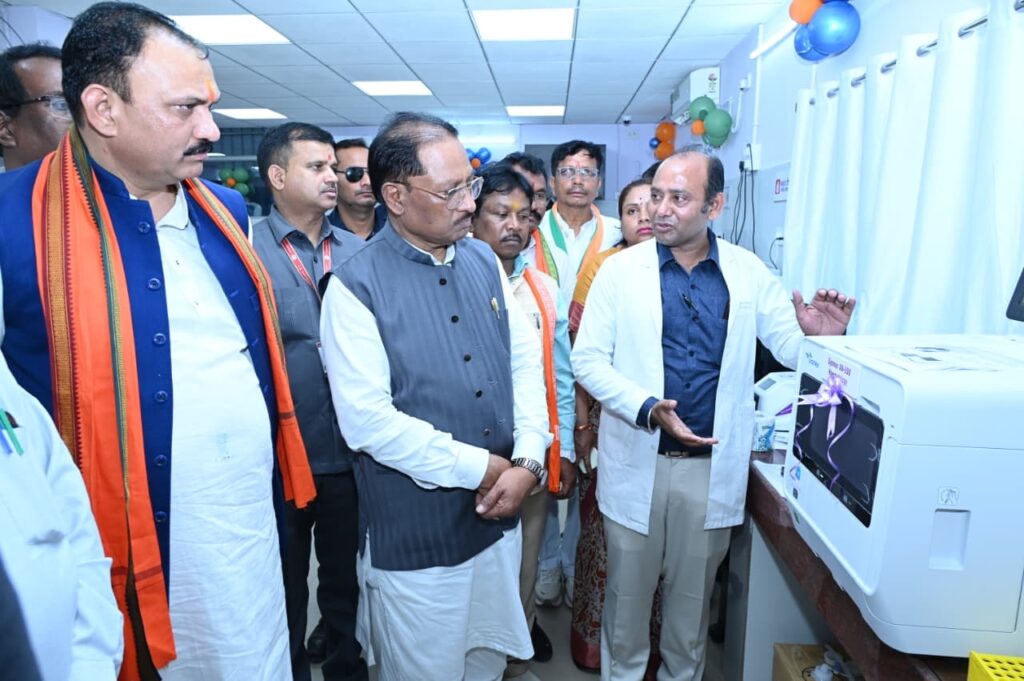
₹308-Crore Development Package for Sukma
In a major development push, the Chief Minister dedicated and laid the foundation stone for 228 projects worth more than ₹308 crore in Sukma district. The projects include foundation-laying for 159 new works and inauguration of 69 completed projects.
Addressing a large gathering at the Mini Stadium in Sukma, Sai said the state government’s foremost priority is the holistic development of areas that remained backward for nearly four decades due to Naxalism.
“Under the guidance of Prime Minister Narendra Modi and Union Home Minister Amit Shah, peace has been restored in Bastar. Now the focus is on rapid and sustainable development,” he said.
He remarked that villages once overshadowed by fear and violence are now witnessing the sound of school bells and the hum of construction activity — signs of renewed confidence and democratic participation. More than 3,000 Maoists have surrendered so far and are being rehabilitated through dedicated centres, he added.
Welfare Outreach and Direct Benefit Distribution
The Chief Minister visited departmental stalls and directly interacted with beneficiaries of various welfare schemes. Assistance materials and certificates were distributed on the spot.
At the Social Welfare Department stall, five beneficiaries who had lost limbs in IED blasts were provided with artificial legs, while wheelchairs and tricycles were distributed to persons with disabilities. Identity cards were also issued to connect eligible beneficiaries with government schemes.
Under the Tribal Development Department, 15 forest rights certificates were distributed, strengthening legal empowerment and land security for tribal families.
At the Forest Department stall, tendupatta collectors received assistance, including a symbolic cheque of ₹4.27 lakh for the Tongpal cooperative society, along with the distribution of collection cards.
To promote self-employment, two e-rickshaws were handed over to rehabilitated women self-help groups, and an appointment letter was given to one beneficiary.
Interacting with women under the National Rural Livelihoods Mission (NRLM), the Chief Minister encouraged them to progress “from Lakhpati Didi to Crorepati Didi,” assuring sustained government support for entrepreneurship and livelihood initiatives.
Niyad Nella Nar 2.0 Expansion
Sai said that under the Niyad Nella Nar Yojana, development works have already been undertaken in over 500 villages through 45 schemes of 17 departments. In its next phase, “Niyad Nellanar 2.0,” the initiative will be expanded to 10 districts to deepen grassroots development.
He also made eight key announcements for the region, including the construction of roads, culverts, bus stands and community halls, as well as renovation of temples and strengthening of public infrastructure.
Health Minister Shyam Bihari Jaiswal, Bastar MP Mahesh Kashyap, Chief Secretary Vikas Sheel, Health Secretary Amit Kataria, Special Secretary to the Chief Minister Rajat Bansal, senior officials, public representatives and a large number of local residents were present on the occasion.
With healthcare expansion and large-scale infrastructure projects moving forward simultaneously, Bastar appears to be entering a new phase — from conflict to confidence, and from neglect to inclusive growth.