- State government launches ambitious Centre of Excellence scheme to bridge the gap between education and employment, equipping students with industry-ready skills and global opportunities.
- Thirty-six major colleges to be upgraded with advanced laboratories, digital learning facilities, research hubs and career guidance centres under Chief Minister Vishnu Deo Sai’s vision for a knowledge-driven Chhattisgarh.
TFP Bureau, Raipur, June 5, 2026: Chhattisgarh is charting a new course in higher education with an ambitious plan to transform traditional colleges into world-class learning hubs, as the state government moves to prepare its youth for global careers in an increasingly competitive knowledge economy.
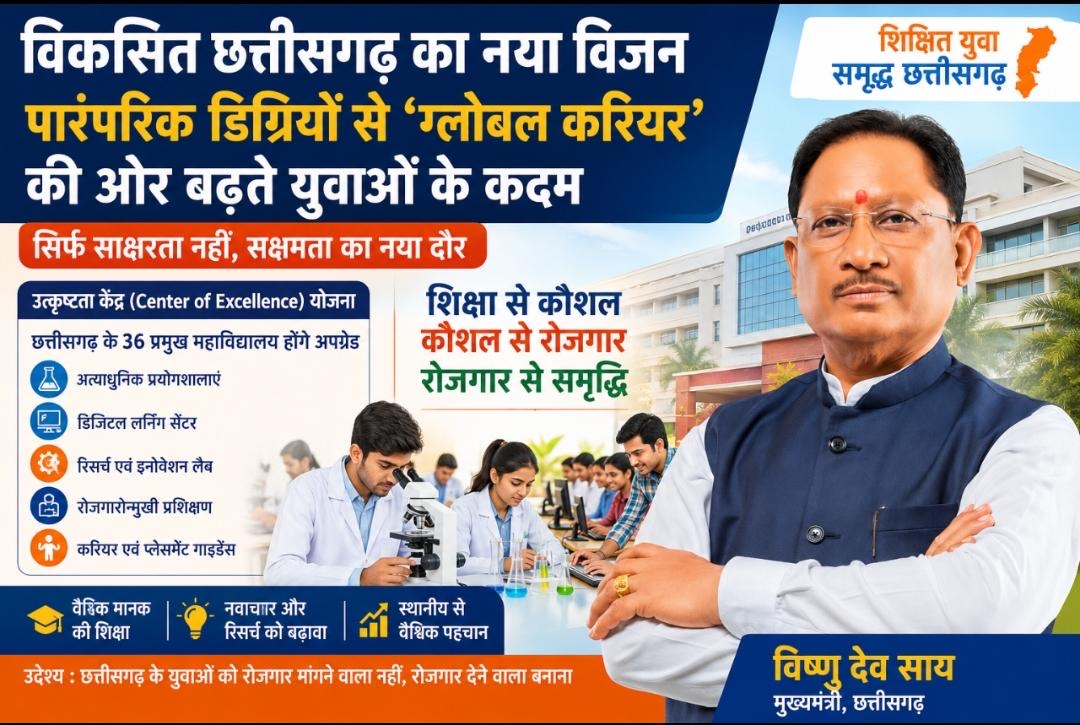
Under the leadership of Chief Minister Vishnu Deo Sai, the state has launched the Centre of Excellence Scheme, a flagship initiative designed to modernize higher education institutions, strengthen research capabilities, and create a skilled workforce capable of meeting the demands of emerging industries.
The initiative comes at a time when the rapid growth of sectors such as artificial intelligence, data analytics, digital technologies, and innovation-driven enterprises is reshaping employment opportunities across the world. While higher education in the state has traditionally focused on academic degrees, policymakers believe a stronger emphasis on practical skills and research is essential to improve employability and competitiveness.
“The future belongs not only to those who are educated but to those who possess the skills, innovation and adaptability required in a global economy,” officials associated with the programme said.
To bridge the gap between education and employment, the government has decided to upgrade 36 major colleges with enrolments exceeding 3,000 students into Centres of Excellence. In the first phase, 25 colleges will receive financial assistance of ₹3 crore each, while select institutions will receive support of up to ₹15 crore in subsequent phases.
The programme aligns with the objectives of the National Education Policy (NEP) 2020 and seeks to establish multidisciplinary, research-oriented institutions capable of delivering global standards of education within the state itself.
Five Pillars of Transformation
The Centres of Excellence will be built around a five-pillar framework aimed at enhancing both academic quality and career outcomes.
Modern laboratories equipped to international standards will be established for science, technology, computer science and agriculture, enabling students to combine theoretical learning with practical experience. High-speed internet connectivity, smart classrooms and digital libraries will strengthen access to global educational resources, particularly for students from rural and tribal regions.
Research and innovation laboratories will encourage students and faculty members to work on solutions to local challenges, including agriculture, tribal art, herbal medicine and mining, helping regional knowledge gain wider recognition.
Employment-oriented training programmes in coding, information technology, entrepreneurship and startup development will prepare students for emerging job markets, while incubation centres will nurture innovation and enterprise.
Dedicated career guidance and placement cells will provide support for competitive examinations, campus recruitment drives and professional counseling.
Benefits to Reach Students Directly
Unlike scholarship-based initiatives, the scheme focuses on institutional empowerment. Students enrolled in designated Centres of Excellence will have access to modern facilities and programmes without additional financial burden.
Officials said transparent registration mechanisms for skill development, research and incubation activities would ensure that students from remote and underserved areas can participate without facing bureaucratic hurdles.
Reducing Migration, Creating Opportunities
The government expects the initiative to reduce educational migration by making high-quality facilities available within students’ home districts. Policymakers believe that improved access to advanced learning environments will encourage entrepreneurship, generate local employment opportunities and strengthen regional economic growth.
By creating a talent ecosystem within the state, Chhattisgarh aims to position itself as a hub of innovation and skilled human resources while supporting the transition from a resource-based economy to a knowledge-driven one.
Vision of a Developed Chhattisgarh
Chief Minister Vishnu Deo Sai has consistently emphasized that the youth of Chhattisgarh should become job creators rather than job seekers. The Centre of Excellence Scheme reflects that vision by providing students with access to modern infrastructure, advanced skills and opportunities for innovation.
Education experts view the initiative as a significant milestone in the state’s educational journey. As the programme expands, the Centres of Excellence are expected to produce graduates equipped not only with academic qualifications but also with the practical skills, entrepreneurial mindset and innovative thinking required to compete on a global stage.
With sustained investment in education, research and skill development, Chhattisgarh is seeking to redefine itself as a knowledge state—one capable of nurturing talent, driving innovation and contributing meaningfully to India’s future growth story.