*Electricity Charges Remain Low in Chhattisgarh Compared to Madhya Pradesh, Maharashtra and Jharkhand
*Modest Tariff Revision Introduced Considering Rising Inflation, Coal Costs, Power Generation and Supply Expenses
Raipur, June 15, 2026/
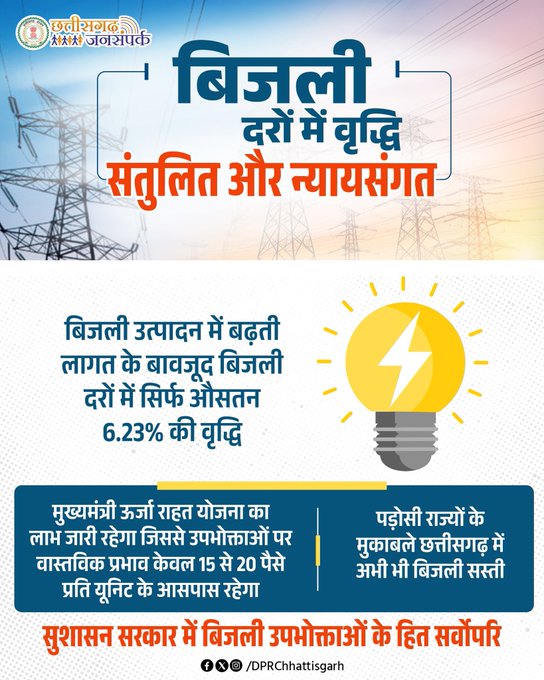
Chhattisgarh State Electricity Regulatory Commission has announced revised electricity tariffs for the financial year 2026–27. The new tariff rates will come into effect from July 1, 2026. The Commission has approved an average increase of 6.23 percent in electricity charges. According to the Commission, the revision has been necessitated by rising inflation, increased coal prices, higher power generation and distribution costs, and the need to offset losses incurred in previous years. The Commission has described the increase as moderate, necessary and justified.
For domestic consumers, electricity tariffs have been increased by an average of 30 paise per unit. However, the actual increase varies by consumption slab. Consumers using up to 200 units of electricity per month will see an increase of 30 paise per unit; those consuming between 201 and 600 units will face an increase of 40 paise per unit; and those consuming above 600 units will face an increase of 50 paise per unit.
The Commission stated that the actual impact on a large number of households in the state is expected to remain around 15 to 20 paise per unit. While revising tariffs, special consideration was given to the interests of the general public and lower-income households.
Under the Mukhyamantri Urja Rahat Yojana, consumers using up to 400 units of electricity continue to pay only half the bill for the first 200 units. As a result, a large number of low- and middle-income households will experience only a limited increase in their electricity expenses. It is estimated that the effective impact on such consumers’ bills will remain around 15 to 20 paise per unit on average.
Similarly, many consumers using between 201 and 600 units of electricity have installed rooftop solar systems under the Pradhan Mantri Surya Ghar: Muft Bijli Yojana and have reduced their grid-based consumption to within 400 units. Such consumers are also expected to experience only a marginal impact from the tariff revision.
Electricity tariffs for non-domestic consumers have been increased by an average of 20 to 40 paise per unit.
For agricultural pump consumers, an increase of 40 paise per unit has been approved. However, due to the subsidy provided by the state government, farmers are not expected to face any direct financial burden from the increase.
Tariffs have also been revised for High-Tension (HT) industrial consumers. For the 220 kV and 132 kV categories, the energy charge has been increased by 30 paise per unit, while the demand charge has been raised by Rs. 25 per kVA. In the 33 kV category, tariffs have been increased by 40 paise per unit, while consumers in the 11 kV category will see an increase of 30 paise per unit.
The revised tariff structure also includes several consumer-friendly provisions. Hostels located in Tribal Development Authority areas of Bastar and Surguja have been shifted from the commercial category to the domestic category, providing significant tariff relief. The delayed payment surcharge mechanism has also been simplified in the interest of consumers. Additional charges will now be levied only for the actual period of delay. Furthermore, domestic and non-domestic consumers with connected loads exceeding 10 kilowatts will receive a rebate of 20 paise per unit for electricity consumption during off-peak hours.
According to the Commission, even after the tariff revision, electricity charges in Chhattisgarh remain lower than those in neighbouring states such as Madhya Pradesh, Maharashtra and Jharkhand.
This ensures that electricity remains competitively priced for both consumers and industries in the state. Overall, while electricity tariffs have increased, the impact on ordinary households is expected to remain limited due to ongoing relief schemes, government subsidies and policies promoting solar energy adoption.