Major policy decisions taken under Chief Minister Vishnu Deo Sai to strengthen education, technology ecosystem, revenue administration and public healthcare
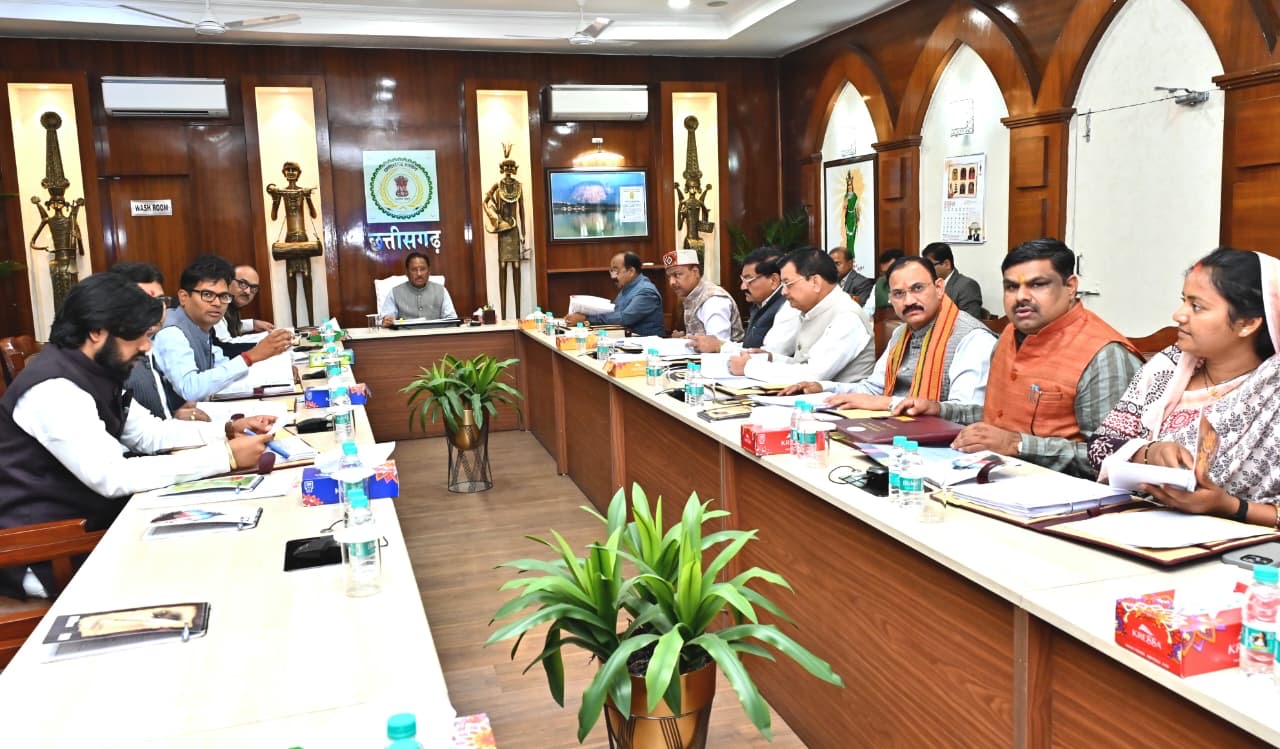
TFP Bureau, Raipur, January 21, 2026: The Chhattisgarh Cabinet, chaired by Chief Minister Shri Vishnu Deo Sai, on Tuesday took a series of far-reaching decisions aimed at strengthening the State’s administrative framework, expanding higher education infrastructure, promoting the IT and start-up ecosystem, and improving public healthcare services. The meeting was held at the Chief Minister’s Residence Office in Civil Lines, Raipur.
Excise Policy for 2026–27 Approved
The Cabinet accorded approval to the Chhattisgarh Excise Policy for the financial year 2026–27. Along with approving the policy framework, the Cabinet authorised the concerned department to undertake all ancillary and consequential actions required for its effective implementation. The decision is expected to provide clarity and continuity in excise administration, strengthen revenue mobilisation, and ensure regulated operations in the sector during the upcoming financial year.
NMIMS Campus to Come Up in Nava Raipur
In a major boost to higher education, the Cabinet approved the allotment of nearly 40 acres of land in Sector-18 of Nava Raipur Atal Nagar to Shri Vile Parle Kelavani Mandal (SVKM) on a 90-year lease. The land has been allotted for the establishment of a campus of the Narsee Monjee Institute of Management Studies (NMIMS), a nationally reputed educational institution.
SVKM has been active in the field of education since 1934 and currently runs around 30 educational institutions across the country. It provides education to more than one lakh students every year, covering programmes from pre-primary to doctoral levels. In the NIRF University Rankings 2025, NMIMS secured the 52nd position. The Cabinet noted that the establishment of this national-level institution in Nava Raipur would significantly enhance access to modern, industry-oriented and quality higher education in Chhattisgarh, while also contributing to the development of the State capital region as an education hub.
MoU with STPI for IT and Start-up Development
To accelerate growth in the IT and ITeS sectors, the Cabinet decided to sign a Memorandum of Understanding (MoU) with the Software Technology Parks of India (STPI) for setting up four new entrepreneurship centres in Nava Raipur Atal Nagar. The initiative is aimed at fostering a robust technology start-up ecosystem and promoting innovation-driven entrepreneurship in the State.
STPI currently operates 68 centres across the country, with 60 located in Tier-2 and Tier-3 cities. In collaboration with the Department of Electronics and Information Technology, Government of Chhattisgarh, STPI will promote around 133 domain-specific start-ups over the next three to five years. These entrepreneurship centres will focus on emerging and priority sectors such as Artificial Intelligence, MedTech based on herbal medicines and forest produce, Smart City solutions, and Smart Agriculture.
The Cabinet also approved the establishment of an Electronics System Design and Development (ESDD) Centre through STPI. This centre will support students, entrepreneurs, researchers and industries in developing prototypes of Electronic System Design and Manufacturing (ESDM) products. The ESDD Centre is expected to provide comprehensive technical and incubation support to 30 to 40 hardware start-ups and MSMEs every year, thereby strengthening local manufacturing and innovation capabilities. Click here to see the video 👇
05aabbec-d08d-4b92-9644-ad0a95737391
Strengthening Diagnostic Facilities in Government Hospitals
In the health sector, the Cabinet took key decisions to ensure the availability of quality diagnostic facilities in all government health institutions across Chhattisgarh. The measures include strengthening existing infrastructure, increasing the range and number of diagnostic tests as per prescribed standards, and ensuring the effective functioning of laboratories.
The decision covers District Hospitals, Community Health Centres and Primary Health Centres throughout the State. The Cabinet emphasised that improved diagnostic services would lead to timely detection of diseases, better treatment outcomes, and reduced dependence of patients on private diagnostic facilities, particularly in rural and remote areas.
Overall, the Cabinet decisions reflect the State Government’s focus on balanced development through policy reforms, investment in education and technology, and improved delivery of public health services.