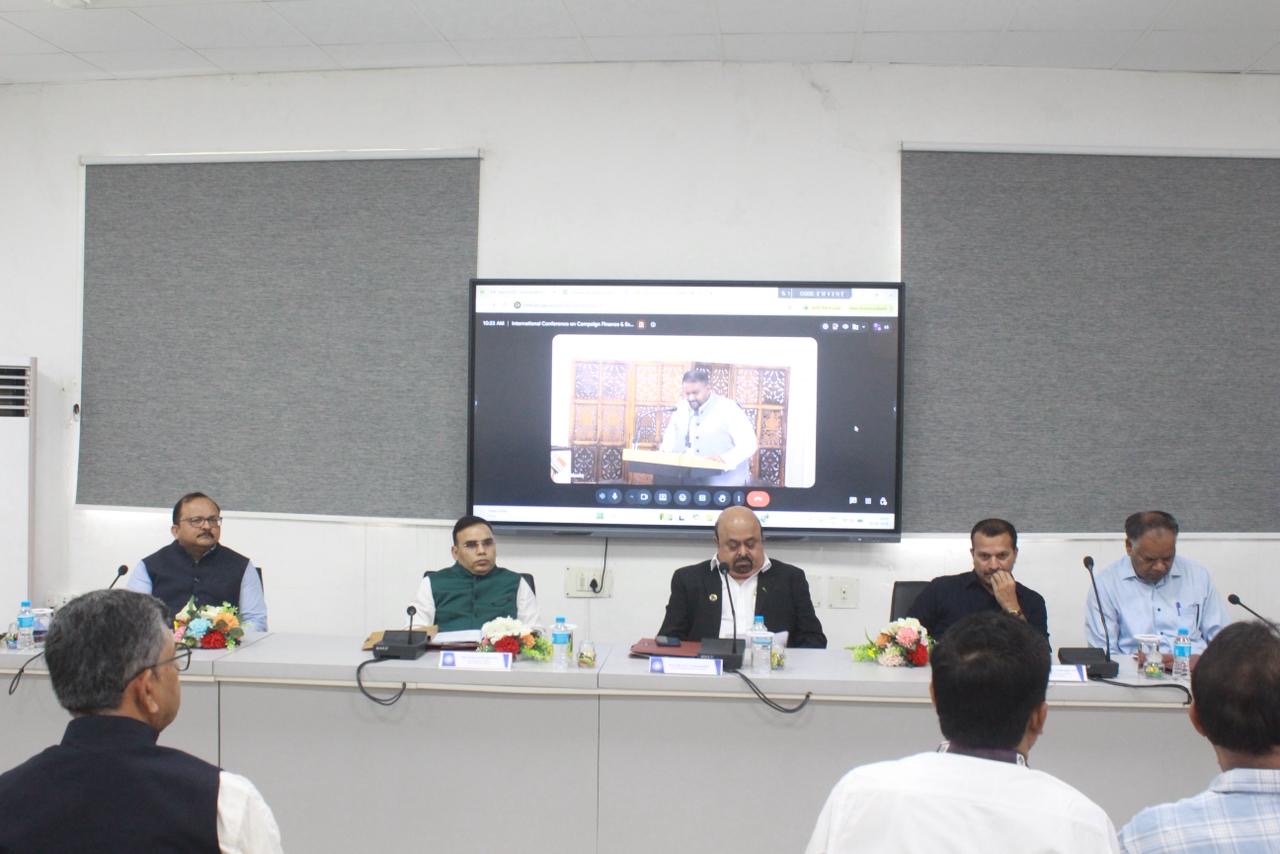
TFP Bureau, Raipur, June 22, 2026: The Office of the Chief Electoral Officer of Chhattisgarh in collaboration with Hidayatullah National Law University (HNLU), Raipur, and the India International Institute of Democracy and Election Management (IIIDEM) and Hayatullah National Law University organized an International Conference on Campaign Finance and Expenditure in Elections. The conference served as a significant platform for election administrators, legal scholars, policymakers, academicians, and researchers to deliberate on one of the most consequential dimensions of democratic governance—campaign finance regulation and electoral expenditure oversight.
The inaugural session set the tone of the day long deliberation which was addressed by Prof. (Dr.) V.C. Vivekanandan, Vice Chancellor, HNLU; Shri Bhoskar Vilas Sandeepan, IAS, Additional Chief Electoral Officer, Chhattisgarh; and Shri Yashwant Kumar, IAS, Chief Electoral Officer, Chhattisgarh. A special presentation on the role of international cooperation in strengthening electoral governance was done by Dr. Kritika Mathur, Assistant Professor, IIIDEM.
Prof Vivekanandan, Vice Chancellor of HNLU also announced that the School of Law & Governance would be launching the ‘Democratic Leadership Academy’ (DLA} with Electoral Reforms as a key focus area.
Conceived against the backdrop of increasing global concerns regarding transparency, accountability, and equity in political financing, the conference explored contemporary approaches to campaign finance regulation, expenditure monitoring, public funding mechanisms, disclosure frameworks, and emerging challenges arising from digital technologies and artificial intelligence.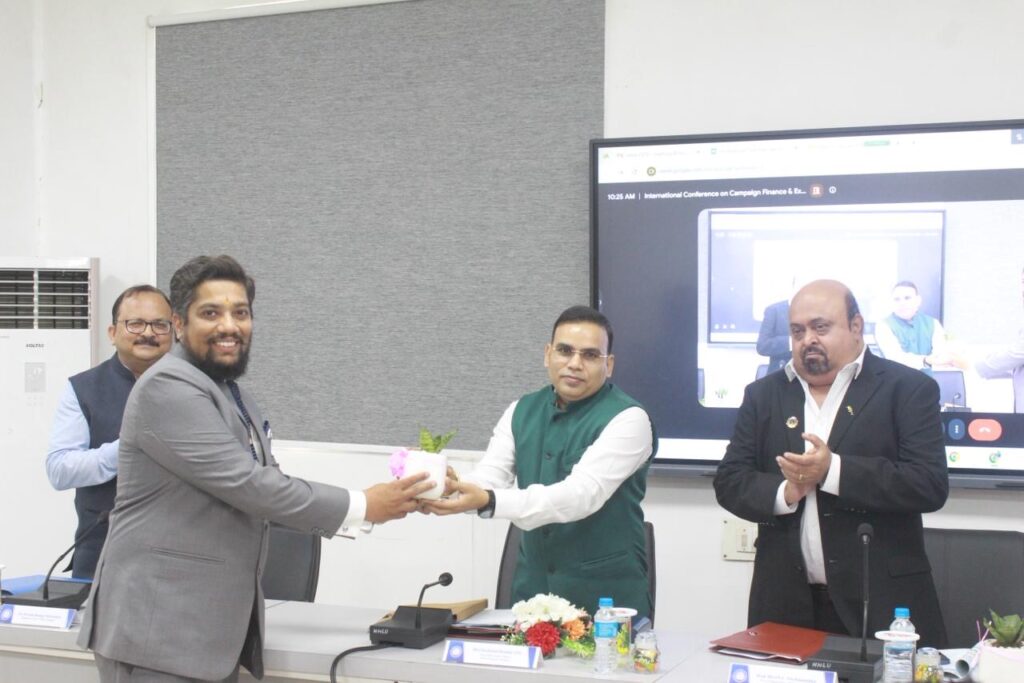
The first technical session, titled “Contribution Regulation: Foundation of a Clean Money Framework,” was moderated by Dr. Anindhya Tiwari, Assistant Professor, HNLU. The session had the panellists Prof. (Dr.) V.C. Vivekanandan and Prof. (Dr.) Yogendra Kumar Srivastava, Director, School of Law and Public Policy, HNLU elucidating views on the theme on the questions posed by the moderator ranging from challenges of digital mode of intangible funding to models of direct funding and accountability .
The second session, “Expenditure Regulation: Controlling the Cost of Democracy,” was moderated by Dr. Mayank Shrivastava, Assistant Professor, HNLU. The panel had Dr. Deepak Kumar Shrivastava, Director of the School of Law and Governance, and Dr. Avinash Samal, Dean, Social Sciences and Student Welfare, HNLU, focussing legal and institutional mechanisms for monitoring campaign expenditure and ensuring regulatory compliance.
The third session, “Public and State Funding: Equitable Architectures for Political Financing,” was moderated by Dr. Eritriya Roy, Assistant Professor, HNLU. The deliberations featured Dr. Rakesh Derhgawen, Professor, Chhattisgarh Education Department, and Mr. Pranav Khandelwal, Advocate, AKP (Abhinav Kardekar & Partners), who explored comparative models of public financing and their potential to enhance fairness and inclusiveness in electoral competition.
The fourth technical session, “Emerging and Cross-Cutting Issues: Digital Frontiers, Organised Crime and AI in Campaign Finance,” was moderated by Dr. Amitesh Deshmukh, Assistant Professor, HNLU. The session featured Dr. Anindhya Tiwari and Prof. (Dr.) Vijay Kumar Singh, Professor and Dean, SRM University, who examined contemporary challenges posed by digital political advertising, illicit funding channels, algorithmic influence, and the growing role of artificial intelligence in electoral processes.
The final technical session, “Disclosure, Transparency and Oversight: Making Campaign Finance Legible,” was moderated by Dr. Debmita Mondal, Assistant Professor, HNLU. The session brought international perspectives through participation from representative of the Election Management Body of South Africa, highlighting global best practices in disclosure systems, transparency mechanisms, and public accountability.
The conference concluded with a valedictory discussion led by Shri Hardik Shrivastava, and Dr. Amitesh Deshmukh, who reflected upon the key takeaways emerging from the deliberations and emphasized the need for evidence-based reforms to strengthen democratic accountability.