CM Directs District Panchayat CEOs to Ensure Last-Mile Delivery of Welfare Schemes, Strengthen Rural Economy and Promote Self-Reliant Villages
Raipur, July 27, 2026: Chief Minister Vishnu Deo Sai on Monday said the vision of a developed Chhattisgarh can only be achieved through the holistic development of villages, stressing that Gram Panchayats should emerge not merely as implementing agencies but as centres of social transformation, economic growth and self-reliant rural development.
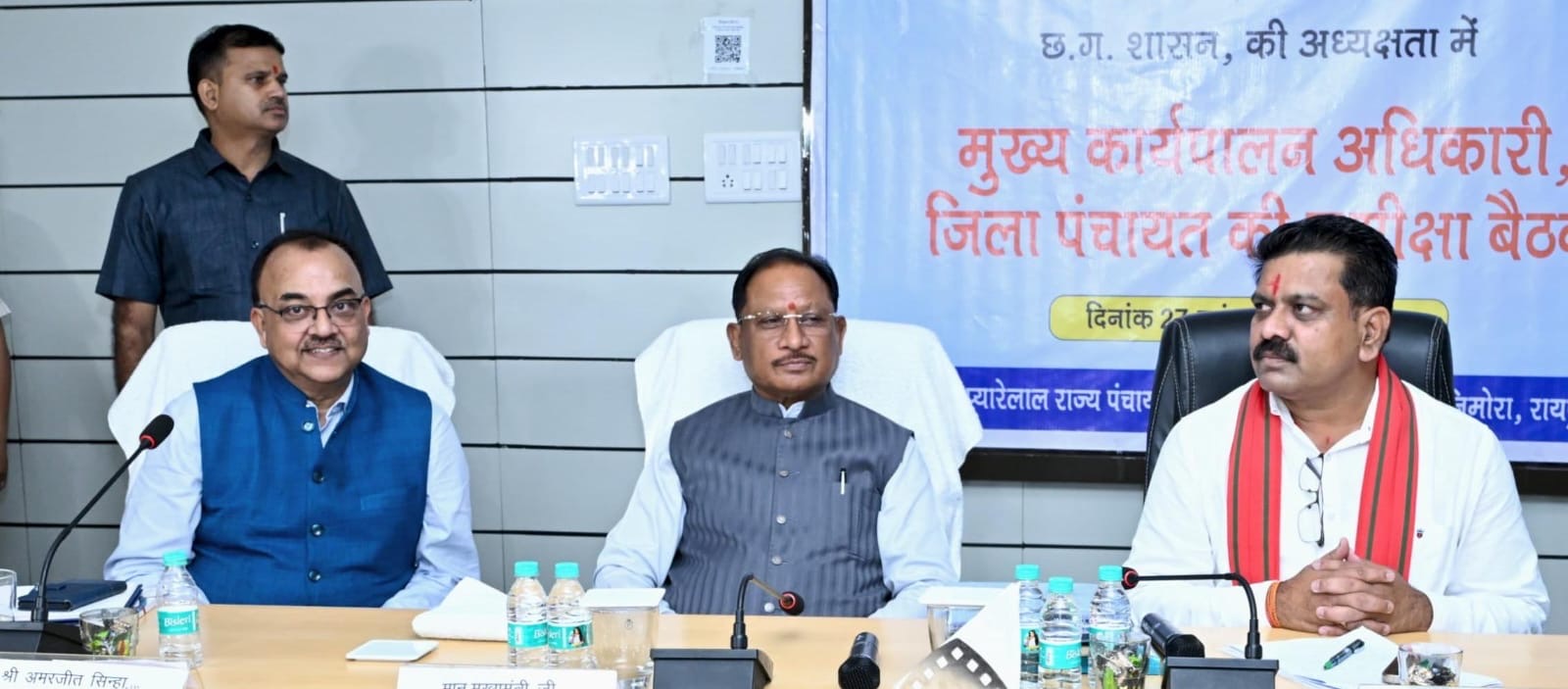
Addressing a high-level review meeting and workshop of Chief Executive Officers (CEOs) of all District Panchayats at the State Institute of Rural Development (SIRD) campus in Nimora, Naya Raipur, the Chief Minister directed officials to ensure the effective implementation of flagship schemes, including the Viksit Bharat Ji Ram Ji Yojana, Lakhpati Didi initiative, Pradhan Mantri Awas Yojana and PM Surya Ghar Muft Bijli Yojana.
Emphasising the importance of good governance, Sai said the true measure of success lies in ensuring that the benefits of government schemes reach the last eligible beneficiary without discrimination. He urged officials to work with honesty, sensitivity and a spirit of public service to strengthen people’s trust in the administration.
The Chief Minister asked district officials to identify villages that can be developed as model villages through public participation, effective planning and optimum use of local resources.
Highlighting the Viksit Bharat Ji Ram Ji Yojana, launched on July 1, Sai described it as a major initiative to strengthen the rural economy. He instructed officials to focus on creating durable community assets, improving rural infrastructure, generating employment opportunities and promoting water conservation. He made it clear that no compromise would be tolerated in the quality of construction work.
Calling for sustainable rural development, the Chief Minister said progress should not be confined to infrastructure alone. Water conservation, soil health, agriculture, livestock development, fisheries and scientific management of natural resources must become integral components of village development plans. He directed every district to prepare location-specific action plans for rainwater harvesting and groundwater recharge.
Sai also highlighted the state’s achievements in women’s empowerment, stating that more than 10.40 lakh women in Chhattisgarh have become “Lakhpati Didis” by earning annual incomes exceeding ₹1 lakh. He said the government is now working towards creating “Crorepati Didis” by connecting women with entrepreneurship, skill development, self-employment opportunities and the state’s new industrial policy.
The Chief Minister instructed District Panchayat CEOs to identify eligible women and facilitate their inclusion in self-help groups, livelihood programmes and skill development initiatives.
Focusing on the Bastar region, Sai directed officials to give priority to development works in remote and previously inaccessible villages. He said roads, electricity, drinking water, housing, healthcare, education and ration facilities are now reaching areas that were once difficult to access, and the government’s objective is to ensure that development benefits every citizen.
Reviewing housing and social welfare programmes, the Chief Minister instructed officials to speed up construction under the Pradhan Mantri Awas Yojana and ensure timely payments under all social security schemes. He also called for stronger Panchayat-level monitoring to improve implementation.
Sai urged officials to promote the PM Surya Ghar Muft Bijli Yojana extensively in rural areas so that more households benefit from solar energy. He also asked departments to encourage the use of solar pumps and other renewable energy solutions among farmers.
Stressing the importance of public service, the Chief Minister said government officials should view their responsibilities as opportunities to contribute to nation-building rather than merely performing administrative duties.
Drawing inspiration from successful rural development models, Sai referred to Padma Shri awardee Popatrao Pawar’s transformation of Maharashtra’s Hivare Bazar village through water conservation, public participation and effective natural resource management. He said determined leadership and community participation can transform any village into a model of sustainable development.
The Chief Minister also urged officials to learn from the rural development initiatives of Nanaji Deshmukh’s Deendayal Research Institute in Chitrakoot and the education-led social transformation pioneered by Dr. Achyuta Samanta in Odisha. He encouraged districts to develop locally relevant development models based on their unique resources and needs.
During the workshop, Padma Shri Popatrao Pawar shared the journey of Hivare Bazar, recalling how the village overcame water scarcity, migration, unemployment and social challenges through collective efforts. He said the village today has eliminated migration, has no Below Poverty Line families, produces nearly 5,000 litres of milk daily and has achieved a per capita income of around ₹9 lakh annually.
The meeting was attended by Deputy Chief Minister Vijay Sharma, Additional Chief Secretary Richa Sharma, Panchayat and Rural Development Secretary Bhim Singh, Director Priyanka Rishi Mahobia, retired IAS officer Amarjit Sinha, District Panchayat CEOs from across the state and senior government officials.