
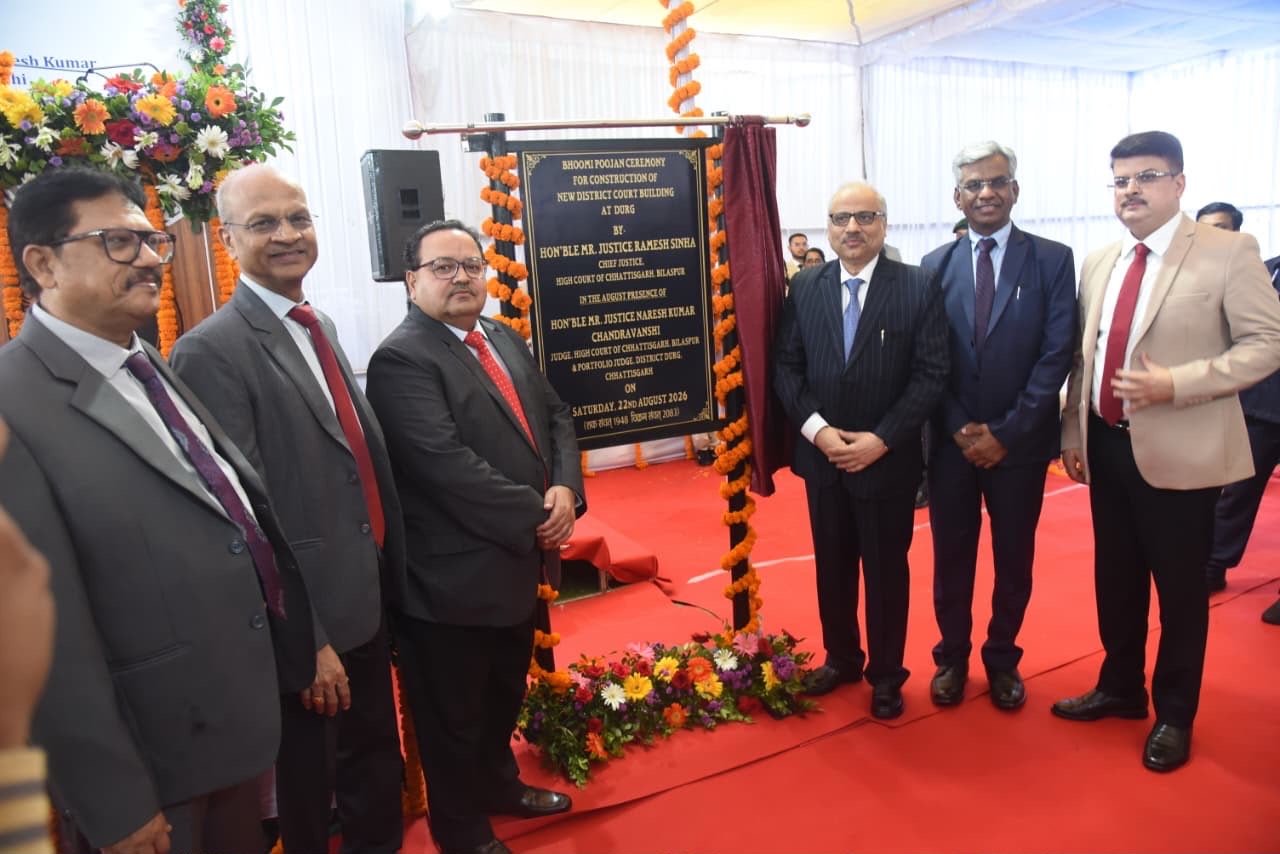
Chief Justice Ramesh Sinha performs foundation stone ceremony; ‘Sandhi Setu’ on community mediation and new digital court services launched
TFP Bureau, Raipur, August 22, 2026: A new chapter in the judicial infrastructure of Durg district began on Saturday with Chhattisgarh High Court Chief Justice Ramesh Sinha performing the ground-breaking and foundation stone laying ceremony for the new Principal District and Sessions Court building in Durg.
The event also witnessed the launch of initiatives aimed at strengthening digital justice and alternative dispute resolution, including a book on community mediation and technology-enabled court services.
Justice P.P. Sahu, Justice Naresh Kumar Chandravanshi, Justice Ravindra Kumar Agrawal, Justice Vibhu Dutt Guru and Justice Amitendra Kishore Prasad were also present on the occasion.
New court complex to provide modern facilities
Principal District and Sessions Judge, Durg, K. Vinod Kujur, welcomed the Chief Justice and other judges and highlighted the need for a modern court complex equipped to meet the future requirements of the district judiciary.
Chief Justice Ramesh Sinha formally performed the ground-breaking ceremony for the proposed building, which is expected to provide improved and better-organised facilities for judicial officers, advocates, court staff and litigants.
The new infrastructure is being viewed as an important step towards strengthening the efficiency and dignity of judicial proceedings in the district.
‘Sandhi Setu’ promotes community-level dispute resolution
The Chief Justice also launched ‘Sandhi Setu’, a publication prepared by the District Legal Services Authority, Durg, focusing on community mediation.
The book highlights efforts to resolve disputes through dialogue, mutual understanding and consensus at the community level. The initiative seeks to encourage peaceful settlement of disputes outside the courtroom and promote a harmonious social environment, particularly in rural areas.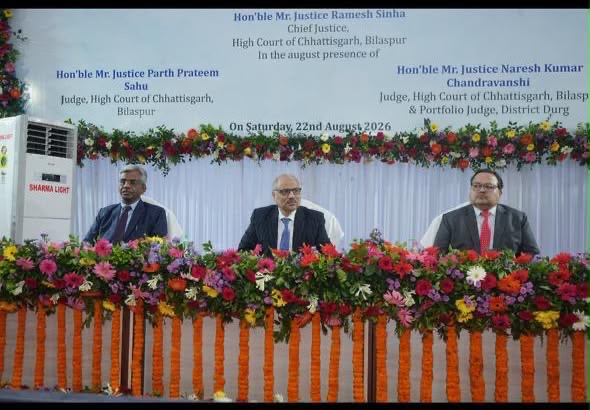
Digital initiatives launched to simplify court services
The programme also featured the launch and presentation of several digital initiatives developed by the Information Technology team of the Chhattisgarh High Court.
These include the Cashless Fine Payment Facility, AFR Mobile Application for Android devices and the Court Fee Ticket Generation System.
The initiatives are aimed at making judicial services more accessible, transparent and technology-driven while reducing procedural difficulties for citizens and other stakeholders.
Chief Justice stresses accessible and people-centric justice
Addressing the gathering, Chief Justice Ramesh Sinha emphasised the importance of modern judicial infrastructure, technological innovation and a people-centric justice delivery system.
He described the construction of the new court building as a significant development for Durg’s judicial system and stressed the need to strengthen judicial institutions in line with future requirements.
Appreciating the digital initiatives and community mediation efforts, he said the effectiveness of the justice system ultimately depends on making justice accessible, simple, transparent and closer to the common people.
Judicial fraternity welcomes Chief Justice
The event was attended by judicial officers, district judiciary officials and staff, advocates, representatives of the Legal Services Authority, administrative officials, paralegal volunteers, social representatives and members of the print and electronic media.
The District Advocates Association, Durg, accorded a warm welcome to the Chief Justice. Members of the State Bar Council elected from Durg district also welcomed him on the occasion.
Principal Judge of the Family Court, Durg, Suman Ekka, proposed the vote of thanks and expressed gratitude to the Chief Justice, judges, judicial and administrative officers, advocates, media representatives and all those associated with the programme.
The foundation stone ceremony, launch of ‘Sandhi Setu’ and introduction of digital judicial services together marked a significant step towards making Durg’s justice delivery system more modern, accessible, technology-enabled and citizen-centric.