
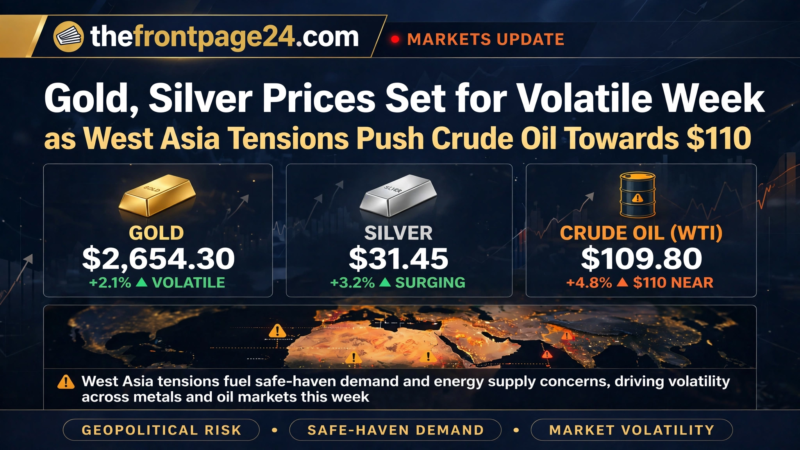
China’s economic data, US inflation indicators, global PMI figures and rupee-dollar movements to shape precious metals market; analysts urge investors to remain cautious
TFP Bureau, New Delhi, October 19,2026: Gold and silver prices are likely to remain volatile in the coming week as escalating tensions in West Asia, crude oil prices approaching $110 per barrel and fluctuations in the rupee add to uncertainty in global financial markets.
Investors will closely track economic indicators from China, inflation-related data from the United States and Purchasing Managers’ Index (PMI) readings from major economies, including India and the UK, for clues about the direction of precious metals prices.
Market analysts believe geopolitical uncertainty could increase demand for gold as a safe-haven asset. However, persistent inflation, expectations of higher interest rates and a stronger US dollar could limit gains or trigger a decline in prices. Silver, meanwhile, will also be influenced by expectations for industrial demand.
West Asia tensions create uncertainty
The evolving situation in West Asia remains a key factor for global markets, with concerns over a possible disruption to energy supplies keeping attention focused on crude oil prices.
A sustained increase in oil prices could raise transportation and manufacturing costs, adding to inflationary pressures across major economies. This could influence central banks’ decisions on interest rates and, in turn, affect the attractiveness of gold and silver.
Gold often benefits when geopolitical risks rise, as investors seek assets perceived as relatively safe during periods of uncertainty. However, if higher oil prices keep inflation elevated and delay interest rate cuts, rising bond yields and a stronger dollar could weigh on gold.
Consequently, escalating geopolitical tensions alone may not guarantee a sustained rally in precious metals.
Crude oil near $110 raises concerns for India
Crude oil prices approaching $110 per barrel pose a particular concern for India, a major oil-importing economy. Higher energy costs could increase the country’s import bill and put pressure on inflation, the rupee and financial markets.
The domestic prices of gold and silver depend not only on international bullion rates but also on the rupee-dollar exchange rate and import-related costs.
A weaker rupee generally makes imported precious metals more expensive in domestic markets, even when international prices remain unchanged. Conversely, a stronger rupee could cushion the impact of rising global prices.
Investors will therefore monitor currency movements alongside international bullion rates to assess the likely direction of domestic prices.
China’s economic indicators in focus for silver
Economic data from China will be another important factor, particularly for silver, which serves both as an investment asset and an industrial metal.
Silver is widely used in electronics, solar energy and other industrial applications. Changes in Chinese manufacturing activity and broader economic demand can therefore influence market expectations for the metal.
Stronger-than-expected economic indicators could improve sentiment towards industrial commodities and support silver prices. Weak data, on the other hand, could raise concerns about industrial demand and put pressure on prices.
The market’s response will depend on how the actual figures compare with expectations and what they signal about the outlook for China’s economy.
US inflation data may influence gold prices
Investors will also watch US economic indicators, including data on the housing market, consumer sentiment and inflation expectations.
Inflation figures are particularly important because they could influence expectations about the US Federal Reserve’s interest rate decisions. If inflation remains persistent, markets may reduce expectations of interest rate cuts, potentially supporting the dollar and bond yields.
Such developments could make non-yielding assets such as gold less attractive. Conversely, softer inflation data or signs of economic weakness could revive expectations of monetary easing and provide support to bullion.
The direction of prices will depend on the strength of the data relative to market forecasts and the implications for future monetary policy.
PMI readings from India, UK and US to provide further cues
Purchasing Managers’ Index data from India, the UK and the US will offer additional insights into manufacturing and services activity.
Stronger PMI readings may indicate improving economic momentum, while weaker figures could point to slowing demand. These signals can influence investor sentiment, currency movements and expectations for industrial commodity consumption.
For silver, the data may help investors assess the outlook for industrial demand. For gold, the implications will depend more broadly on how the readings affect expectations for interest rates, the dollar and global risk appetite.
Investors advised to watch multiple market signals
With geopolitical developments, crude oil prices, currency movements and economic data all likely to influence precious metals, analysts expect the coming week to require careful monitoring.
Investors should avoid making decisions based on a single headline or assuming that geopolitical uncertainty will automatically push gold and silver higher. The interaction between inflation, interest rates, the dollar and industrial demand could produce movements in either direction.
For domestic investors, the rupee-dollar exchange rate and local market conditions will be as important as international bullion prices. Assessing risk tolerance and investment horizons before making investment decisions will be particularly important during a period of heightened uncertainty.