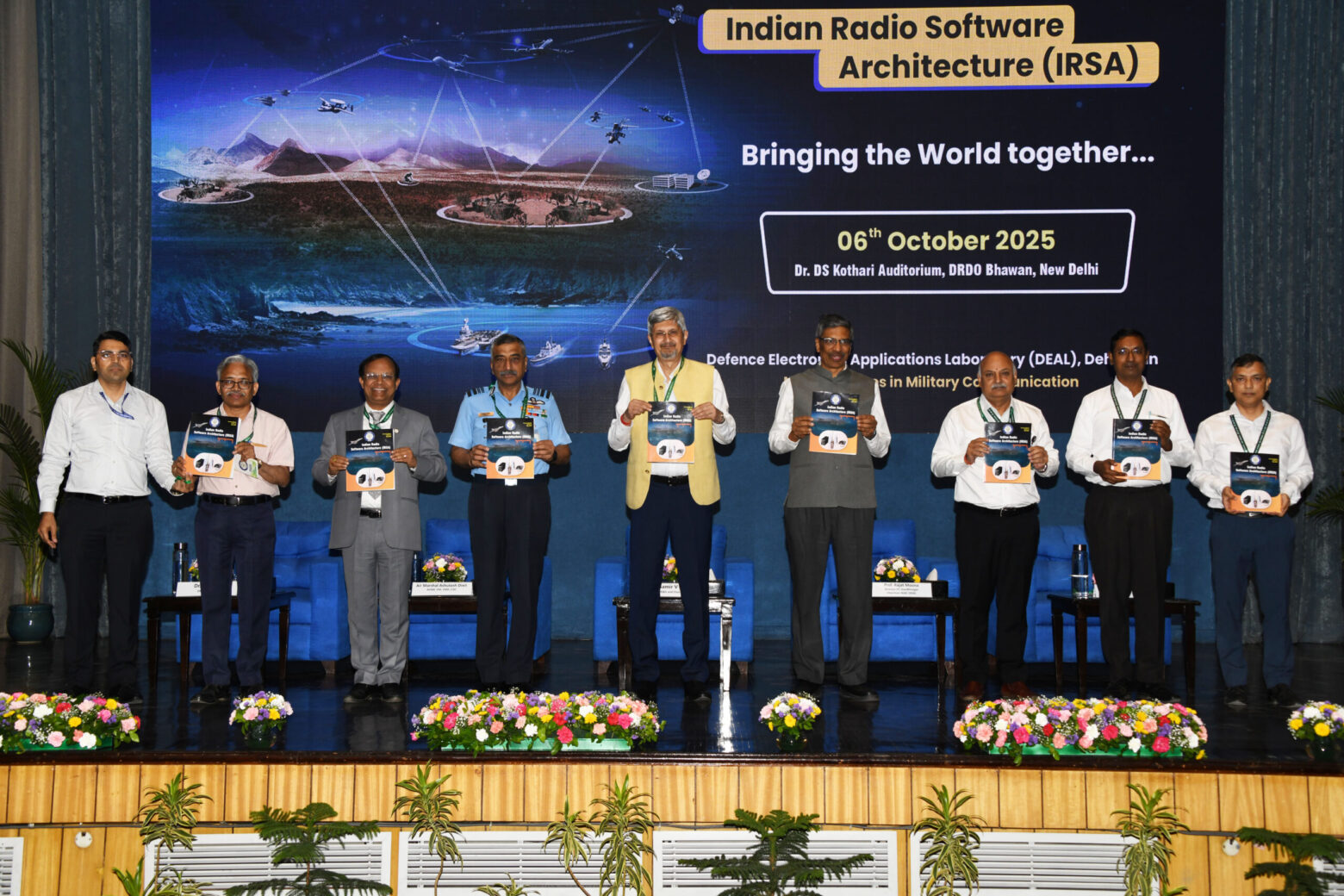
TFP Bureau, New Delhi, October 7, 2025: The Defence Research and Development Organisation (DRDO), in collaboration with the Integrated Defence Staff (IDS) and the Tri-Services, has formally released the Indian Radio Software Architecture (IRSA) Standard 1.0 — a landmark specification designed to ensure interoperability among Software Defined Radios (SDRs) used by the Indian Armed Forces. The official launch took place at a national workshop held at DRDO Bhawan, New Delhi, on October 6, 2025.
IRSA 1.0 represents a significant leap in India’s pursuit of self-reliance in defence communication technology. The new standard provides a unified software framework for SDRs, defining standardized interfaces, Application Programming Interfaces (APIs), execution environments, and mechanisms for waveform portability. It aims to ensure seamless communication and compatibility across diverse radio platforms used by the Army, Navy, and Air Force, thereby enhancing operational efficiency and mission coordination in multi-domain warfare scenarios.
The launch marks a key milestone in India’s “Aatmanirbhar Bharat” initiative in defence technology, embodying the vision of developing indigenous, secure, and globally competitive SDR solutions — “designed in India, for India, and ready for the world.”
The event was presided over by Dr. Samir V. Kamat, Secretary of the Department of Defence Research and Development (DDR&D) and Chairman of DRDO, who served as the Chief Guest. Air Marshal Ashutosh Dixit, Chief of Integrated Defence Staff, and Dr. Rajat Moona, Director of IIT Gandhinagar, graced the occasion as Guests of Honour. The workshop, organised under the guidance of Dr. B.K. Das, Director General (Electronics and Communication Systems), brought together representatives from the Armed Forces, Department of Defence Production (DDP), Defence Public Sector Undertakings (DPSUs), academia, and private industry.
The workshop traced the development journey of IRSA from concept to implementation, highlighting its technical architecture, ecosystem roles, and future roadmap. It also served as a collaborative platform for industry, research institutions, and defence establishments to discuss pilot projects, technology integration, and adoption strategies.
According to DRDO, the IRSA initiative began in 2021 after the growing importance of SDRs in modern network-centric warfare became evident. Recognizing the need for a unified software standard, DRDO set up a core technical team in 2022, which worked closely with IDS and the Tri-Services to identify operational requirements. Following multiple rounds of stakeholder consultations and rigorous technical evaluations, IRSA Version 1.0 was approved by the High-Level Advisory Committee (HLAC) in 2025.
The adoption of IRSA 1.0 establishes a robust foundation for future evolution of military communication systems. It is designed to adapt to emerging technologies, including artificial intelligence-based signal processing, cyber-resilient communication, and satellite-integrated networking.
Officials emphasized that the new standard would not only strengthen India’s defence communication ecosystem but also pave the way for the export of IRSA-compliant SDR solutions to friendly nations, positioning India as a global leader in defence communication standards.
The introduction of IRSA 1.0 underscores DRDO’s commitment to technological innovation and collaboration across government, industry, and academia — reaffirming India’s strategic goal of building a modern, networked, and fully interoperable defence force equipped for the challenges of the future battlefield.