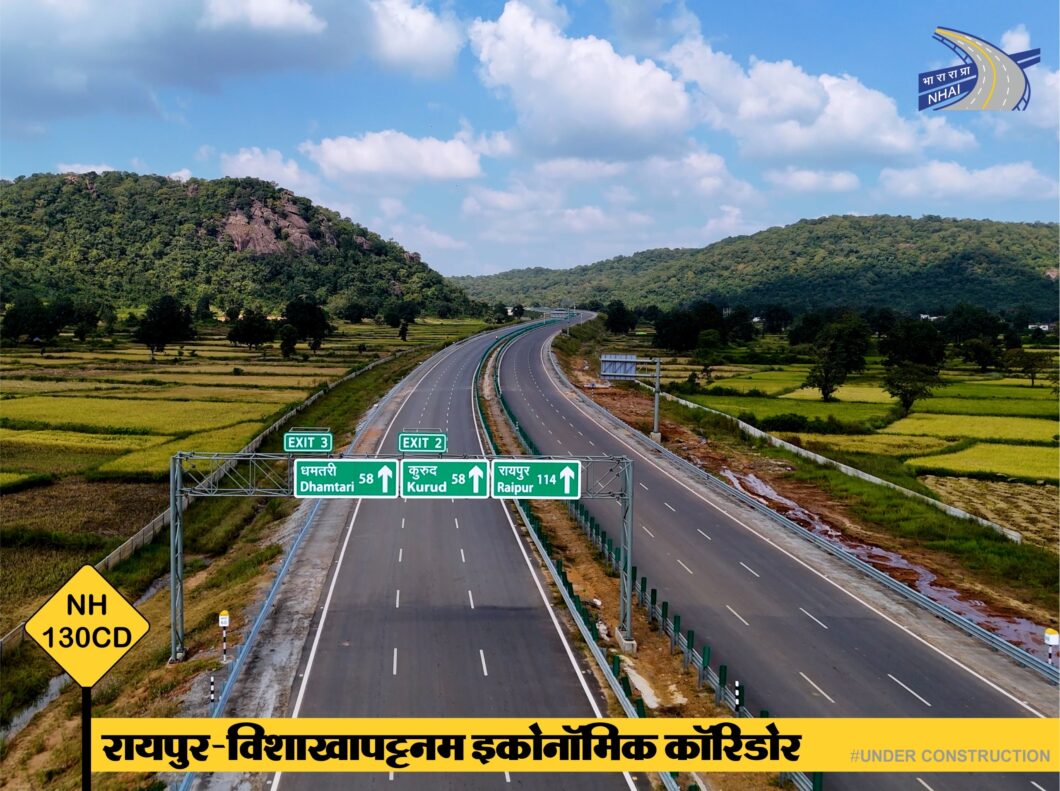
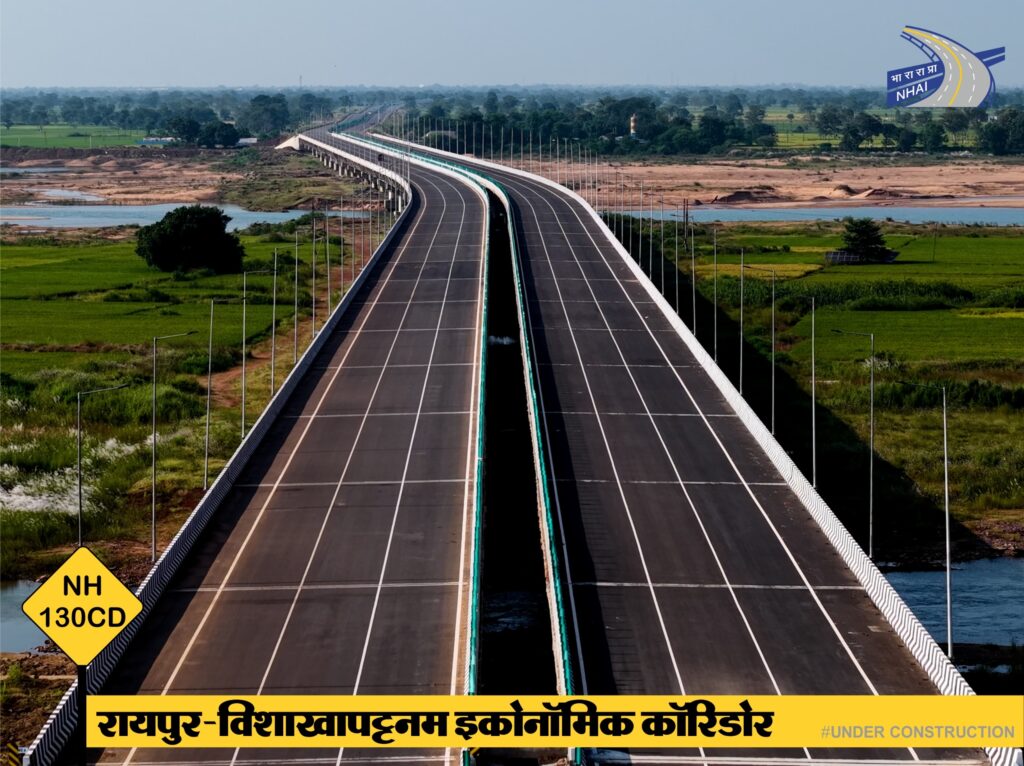
Six-lane greenfield highway under Bharatmala to transform trade, tourism and tribal economy with seamless connectivity to Visakhapatnam Port
TFP Bureau, Raipur, April 19, 2026: In a major infrastructure push poised to redefine the economic landscape of south Chhattisgarh, the ambitious Raipur–Visakhapatnam Economic Corridor is set to provide landlocked Bastar with direct connectivity to the eastern seaboard. Once completed, the six-lane access-controlled greenfield corridor will reduce travel time between Jagdalpur and Visakhapatnam to just about four hours, creating an efficient gateway to global markets for the tribal-dominated region.
Being developed under the Bharatmala Pariyojana, the 464-kilometre-long corridor is estimated to be constructed at a cost of approximately ₹16,491 crore. Officials describe it as one of the most transformative infrastructure projects for Chhattisgarh, particularly for the Bastar division, which has long grappled with limited connectivity due to its rugged terrain and forested geography.
Travel Time to Be Nearly Halved
At present, commuters and freight carriers travelling from Jagdalpur to Visakhapatnam must navigate the challenging hill stretches of Koraput and Jeypore in Odisha, a journey that typically takes seven to nine hours. Heavy vehicles often face steep gradients, sharp turns and higher fuel consumption, increasing operational costs and transit risks.
The new corridor will bypass these difficult ghat sections, bringing travel time down to approximately 3.5 to 4 hours. Logistics operators anticipate significant savings in fuel, maintenance and turnaround time, making freight movement smoother and more cost-effective. The improved highway geometry and access control are also expected to enhance road safety.
Gateway Through Nabarangpur Interchange
The corridor will pass through key districts of Chhattisgarh including Raipur, Dhamtari, Kanker and Kondagaon before entering Odisha. For Bastar, the Daspur Interchange at Nabarangpur in Odisha will serve as the crucial link point. Jagdalpur will be just 50–60 kilometres away from this interchange, allowing direct and swift access to the corridor.
From there, goods can move seamlessly to Visakhapatnam Port, one of the major maritime gateways on India’s eastern coast. The connectivity is expected to remove the long-standing disadvantage of Bastar’s landlocked location and integrate the region more closely with national and international supply chains.
Boost to Bastar’s Local Economy and Exports
The corridor is projected to have a far-reaching impact on Bastar’s local economy. The region is known for its distinctive products such as Arabica coffee cultivated in the hills, organic tamarind, mahua-based forest produce, and the traditional Dhokra metal craft created by tribal artisans. With reduced logistics costs and faster port access, these products are expected to gain improved competitiveness in global markets.
Farmers, forest produce gatherers and self-help groups engaged in value addition are likely to benefit from higher price realization and expanded market reach. Officials believe the project will strengthen agro-processing units and encourage new investments in food processing and handicraft sectors.
Industrial and Mineral Advantages
Bastar is rich in mineral resources, particularly iron ore. The corridor will provide faster evacuation routes for minerals to Visakhapatnam Port, potentially boosting exports and reducing transportation bottlenecks. The improved connectivity is also expected to stimulate the development of industrial clusters along the highway stretch.
Industrial centres such as Raipur, Durg-Bhilai and Visakhapatnam will become more closely integrated, fostering inter-state trade and supply chain efficiency. Experts suggest that ancillary industries, warehousing hubs, cold storage facilities and logistics parks may emerge along the corridor, generating large-scale employment.
 Social Development and Service Delivery
Beyond trade and industry, the project is expected to significantly improve access to essential services. Remote and aspirational districts such as Bastar, Kanker and Kondagaon will benefit from better connectivity to educational institutions, healthcare facilities and administrative centres. Faster road access can reduce emergency response time and improve overall quality of life for residents in interior villages.
The enhanced infrastructure is also anticipated to create employment opportunities for local youth in construction, transportation, hospitality, retail and allied service sectors.
Tourism to Receive Major Impetus
Improved connectivity is expected to attract more domestic and international tourists to Bastar’s cultural and natural attractions. Iconic events such as the famed Bastar Dussehra, along with sites like the Danteshwari Temple, Dholkal Ganesh idol, Kutumsar Cave, Chitrakote Falls and Tirathgarh Falls, may witness increased footfall. Tourism stakeholders believe easier access could significantly boost hospitality and eco-tourism ventures in the region.
Engineering Feat with Environmental Safeguards
One of the standout engineering components of the corridor is the 2.79-kilometre twin-tube tunnel being constructed at Majhingarh Hill near Basanwahi in the Keshkal region of Kanker district. This will be Chhattisgarh’s first such tunnel and is being developed with careful consideration of environmental sensitivities, as it passes near the Udanti-Sitanadi Tiger Reserve.
Wildlife-friendly features such as animal underpasses, overpasses and canopy bridges are being incorporated to ensure safe animal movement and ecological balance, reflecting efforts to harmonize infrastructure expansion with environmental conservation.
Leadership’s Vision
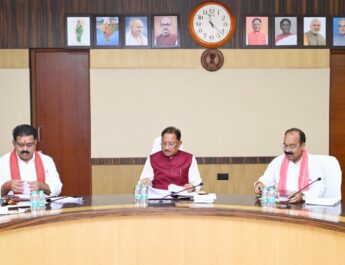
Chief Minister Vishnu Deo Sai described the corridor as a gateway to a new era of development for Bastar and the state. He stated that the project would reduce travel time, lower transportation costs and connect local products directly to global markets, contributing to inclusive growth and the vision of a self-reliant Chhattisgarh.
Deputy Chief Minister and PWD Minister Arun Sao said the corridor would provide fresh momentum to industrial growth and trade by creating a world-class road network that ensures safer and faster movement of passengers and goods.
As construction progresses, the Raipur–Visakhapatnam Economic Corridor is widely seen as a landmark initiative that could permanently alter Bastar’s economic trajectory, transforming it from a remote hinterland into a region firmly connected with national and global markets.