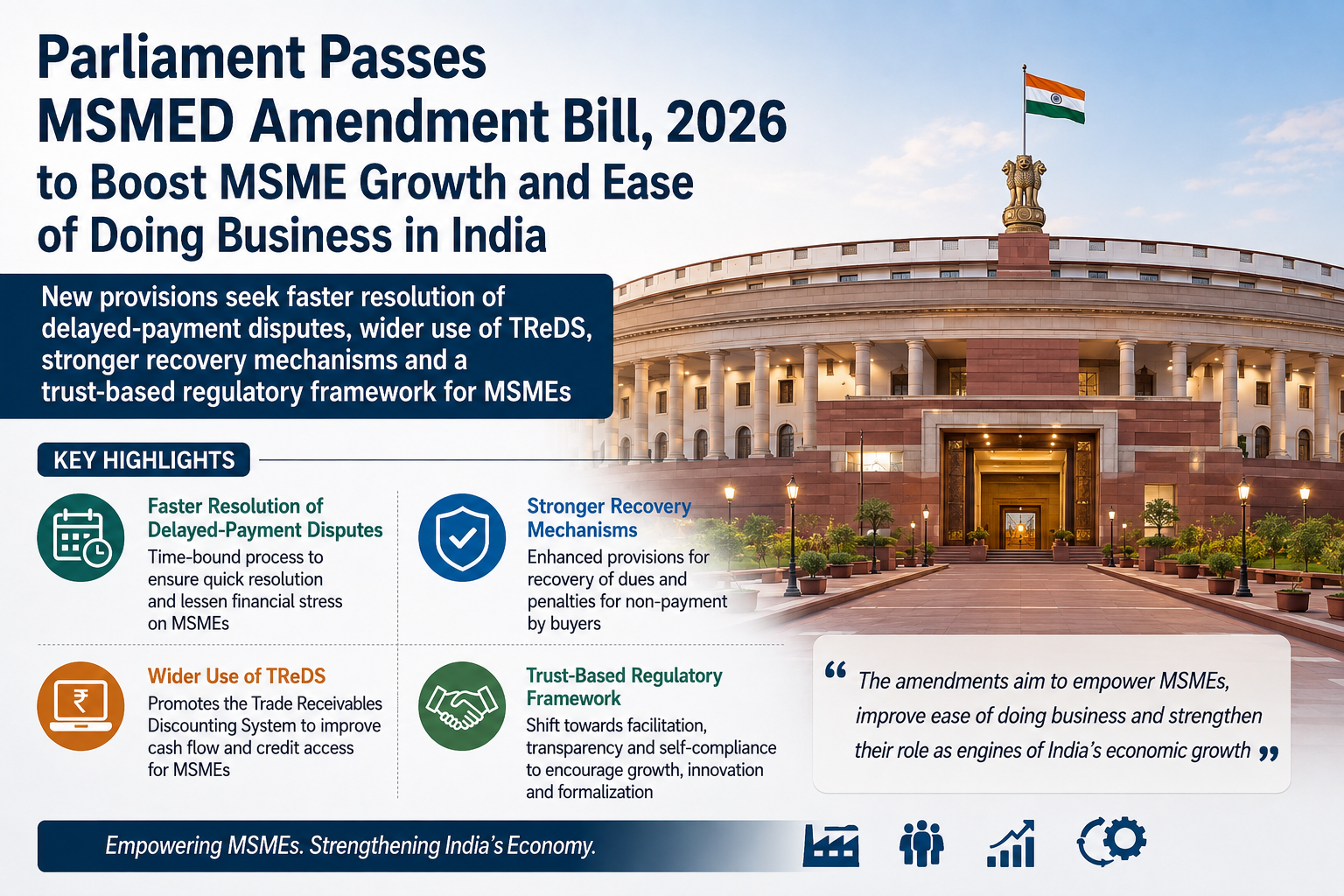
New provisions seek faster resolution of delayed-payment disputes, wider use of TReDS, stronger recovery mechanisms and a trust-based regulatory framework for MSMEs
TFP Bureau, New Delhi, August 10, 2026: Parliament has passed the Micro, Small and Medium Enterprises Development (Amendment) Bill, 2026, aimed at strengthening the legal and institutional framework governing the MSME sector, facilitating business growth and addressing longstanding concerns over delayed payments.
The Bill was passed by the Lok Sabha on August 7, following its passage in the Rajya Sabha on August 3. The amendments come two decades after the enactment of the Micro, Small and Medium Enterprises Development Act, 2006, amid significant changes in the country’s MSME ecosystem driven by technology, digital platforms and evolving business regulations.
According to the government, the number of enterprises registered on the Udyam portal has increased from 1.65 crore on April 1, 2023, to 9.16 crore currently. The MSME sector provides employment to more than 40 crore people and remains a key pillar of India’s economy.
The amended legislation seeks to improve ease of doing business, strengthen mechanisms for resolving delayed-payment disputes, facilitate faster recovery of dues and promote a more enabling and trust-based regulatory environment.
A key provision is the formal recognition of the Udyam Registration Portal as a digital, free and voluntary registration platform. MSME classification based on investment in plant and machinery and turnover has also been incorporated into the Act, aligning the legal framework with the changing structure of the sector.
The amendments introduce an Online Dispute Resolution mechanism to help Micro and Small Enterprises (MSEs) resolve payment-related disputes more quickly and cost-effectively. Courts will also be required to order payment of at least 50 per cent of the awarded amount to MSE suppliers where an application challenging a decree, award or order has remained pending for more than six months.
The legislation prescribes specific timelines for resolving delayed-payment disputes. Mediation will have to be completed within 90 days from the date fixed for the first appearance, while cases will have to be referred for arbitration within 30 days of the termination of mediation. The arbitral award is required to be made within 90 days of completion of pleadings.
The amended framework also strengthens recovery of dues. Mediated settlement agreements and arbitral awards made through the Facilitation Council or recognised alternative dispute-resolution mechanisms can be recovered as arrears of land revenue through the District Collector, Deputy Commissioner or other notified authority in the jurisdiction where the buyer’s assets are located.
Another significant provision relates to the Trade Receivables Discounting System (TReDS). All Central Public Sector Enterprises (CPSEs) will be required to route settlement of invoices for goods and services procured from MSMEs through TReDS. The framework also enables state governments to encourage their public sector enterprises to use the platform.
The government said TReDS has emerged as an important institutional mechanism for improving liquidity and ensuring timely payments to MSMEs. Invoice discounting through the platform increased from ₹40,000 crore in 2022-23 to ₹3.47 lakh crore in 2025-26.
The Bill also provides greater flexibility to state governments in constituting Micro and Small Enterprises Facilitation Councils (MSEFCs), enabling the creation of multiple councils for faster disposal of payment-related disputes. States will also have greater authority to frame rules governing the functioning of these councils.
In a move aimed at improving ease of doing business, several penal provisions have been decriminalised and replaced with graded civil penalties. For certain violations, including furnishing incorrect information, the amended framework provides for a warning for the first instance followed by penalties for subsequent violations.
Similarly, provisions relating to non-disclosure of unpaid amounts and interest in annual accounts by buyers have been shifted from conviction-based penalties to a graded system involving warnings, penalties and fines depending on the frequency of violation.
The government said the amendments are aligned with the vision of Viksit Bharat @2047 and are expected to promote formalisation, facilitate scaling-up of enterprises and strengthen the MSME sector as a driver of inclusive, sustainable and employment-intensive economic growth.
The new framework is also expected to improve compliance, strengthen institutional support for entrepreneurs and create a more predictable business environment for India’s vast MSME community.