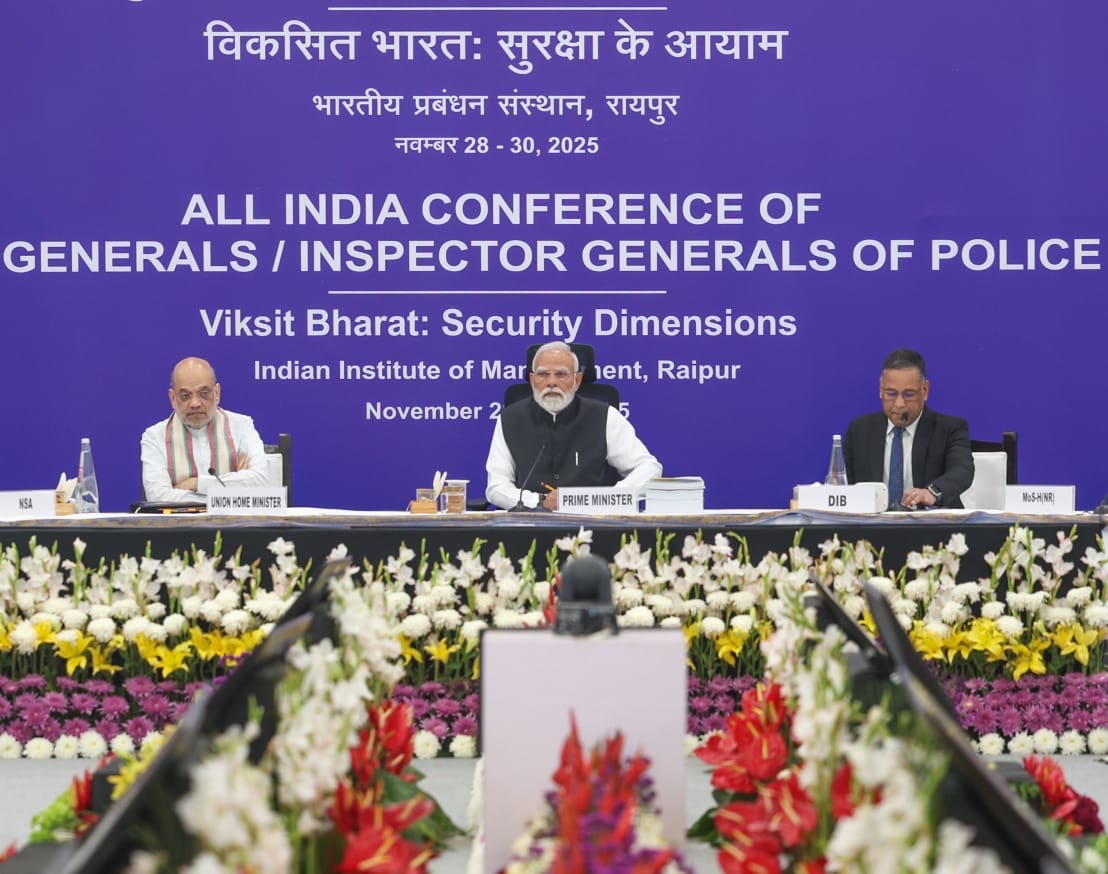
TFP Bureau, Raipur, November 30, 2025 — Prime Minister Narendra Modi presided over the 60th All India Conference of Director Generals and Inspector Generals of Police at the Indian Institute of Management, Raipur, setting a comprehensive agenda for future-ready policing under the theme “Viksit Bharat: Security Dimensions.” The three-day national conference brought together the country’s top police leadership for wide-ranging discussions on security preparedness, law enforcement reforms, and the role of technology in shaping India’s policing landscape.
Addressing the gathering, the Prime Minister stressed the urgent need to transform public perception of the police, particularly among young citizens. He emphasised professionalism, sensitivity, and a stronger service-oriented approach as key to deepening public trust. Enhancing urban policing, revitalising tourist police networks, and spreading awareness about India’s new criminal laws—the Bharatiya Nyay Sanhita, Bharatiya Sakshya Adhiniyam and Bharatiya Nagrik Suraksha Sanhita—were highlighted as immediate priorities.
A major thrust of the Prime Minister’s address centered on technology integration, including expanded use of Artificial Intelligence and deeper linkages with NATGRID to generate actionable, real-time intelligence. He called for innovative strategies to secure uninhabited islands, modernise coastal security frameworks, and further strengthen AI-enabled surveillance and crime prevention systems.
Underlining the need for enhanced forensic capacity, the Prime Minister encouraged universities and academic institutions to undertake research and case studies on forensic applications in criminal investigations. Greater reliance on forensic tools, he said, would strengthen the justice system and help deliver quicker, evidence-based outcomes.
The conference also held detailed deliberations on national security priorities. Senior officers discussed the long-term policing roadmap for Vision 2047, emerging trends in counter-terrorism and counter-radicalisation, strategies for the safe return of fugitives from abroad, and the need for advanced technological solutions to improve women’s safety. Strengthening monitoring mechanisms for banned organisations and ensuring holistic development in regions freed from Left-Wing Extremism were also key areas of discussion.
Disaster preparedness featured prominently, with the Prime Minister urging Police Chiefs to reinforce coordination mechanisms for responding to cyclones, floods and other natural emergencies, including the ongoing situation arising from Cyclone Ditwah. He said that proactive planning, real-time information flow and a Whole-of-Government approach were essential to ensuring minimal disruption during disasters.
Calling upon the police leadership to modernise and realign policing practices with the national vision of Viksit Bharat, the Prime Minister said that India’s evolving aspirations demand a new style of policing that is people-centric, technologically empowered and globally benchmarked.
 During the event, the Prime Minister presented the President’s Police Medals for Distinguished Service to Intelligence Bureau officers. He also honoured the top-performing cities under the newly instituted Urban Policing Awards, introduced to encourage innovation and excellence in policing urban spaces.
Union Home Minister Amit Shah, the National Security Advisor, Ministers of State for Home Affairs, the Union Home Secretary, and DGsP and IGsP from all States and Union Territories attended the conference. Heads of Central Armed Police Forces and Central Police Organisations were also present, while more than 700 officers across the country joined virtually.