
Chief Minister Vishnu Deo Sai says direct benefit schemes bringing prosperity to farmers, labourers and women across Chhattisgarh
TFP Bureau, Raipur, March 25, 2026: In a major welfare initiative aimed at strengthening rural livelihoods, Chief Minister Vishnu Deo Sai on Wednesday transferred over ₹495 crore directly into the bank accounts of nearly 4.96 lakh landless agricultural labourers under the Deendayal Upadhyay Landless Agricultural Laborer Welfare Scheme, marking what he described as a decisive step towards economic dignity and empowerment.
Addressing a state-level programme in Balodabazar, the Chief Minister said that while farmers celebrated a prosperous Holi following timely payments for paddy procurement, the festival of Navratri has now brought financial security and renewed confidence to landless labourers. He emphasised that the government’s “good governance” model is ensuring that benefits reach the last mile with speed and transparency.
A total amount of ₹495.96 crore was transferred to 4,95,965 beneficiaries across the state, with each eligible labourer receiving ₹10,000 annually. The Chief Minister noted that the scheme is designed not merely as financial assistance but as a mechanism to support essential needs such as education, healthcare, and small livelihood activities for rural families.
Highlighting the broader impact of welfare initiatives, Shri Sai said that the state government is fulfilling the guarantees associated with Narendra Modi with commitment and efficiency. He pointed out that farmers benefitted from paddy procurement at ₹3,100 per quintal, enabling them to celebrate Holi with satisfaction, while women have gained financial independence through schemes like Mahtari Vandan Yojana, especially after receiving assistance on International Women’s Day.
During the programme, the Chief Minister also handed over keys to beneficiaries under the Pradhan Mantri Awas Yojana, facilitating housewarming ceremonies and symbolising improved housing security for rural families. He informed that over 18 lakh houses have been sanctioned in the past two years, significantly improving living conditions for the economically weaker sections.
Recalling the rich cultural legacy of Balodabazar, the Chief Minister paid tributes to revered figures such as Baba Guru Ghasidas, Sant Kabir, and freedom fighter Veer Narayan Singh, while reiterating the government’s commitment to inclusive growth rooted in social and cultural values.
Shri Sai further highlighted key initiatives aimed at boosting rural and agricultural development, including large-scale irrigation projects worth over ₹10,000 crore, increased procurement rates for tendu leaves, and revival of welfare schemes such as Charan Paduka Yojana. He also mentioned pilgrimage initiatives like Ramlala Darshan and Mukhyamantri Teerth Darshan, aimed at social and spiritual empowerment.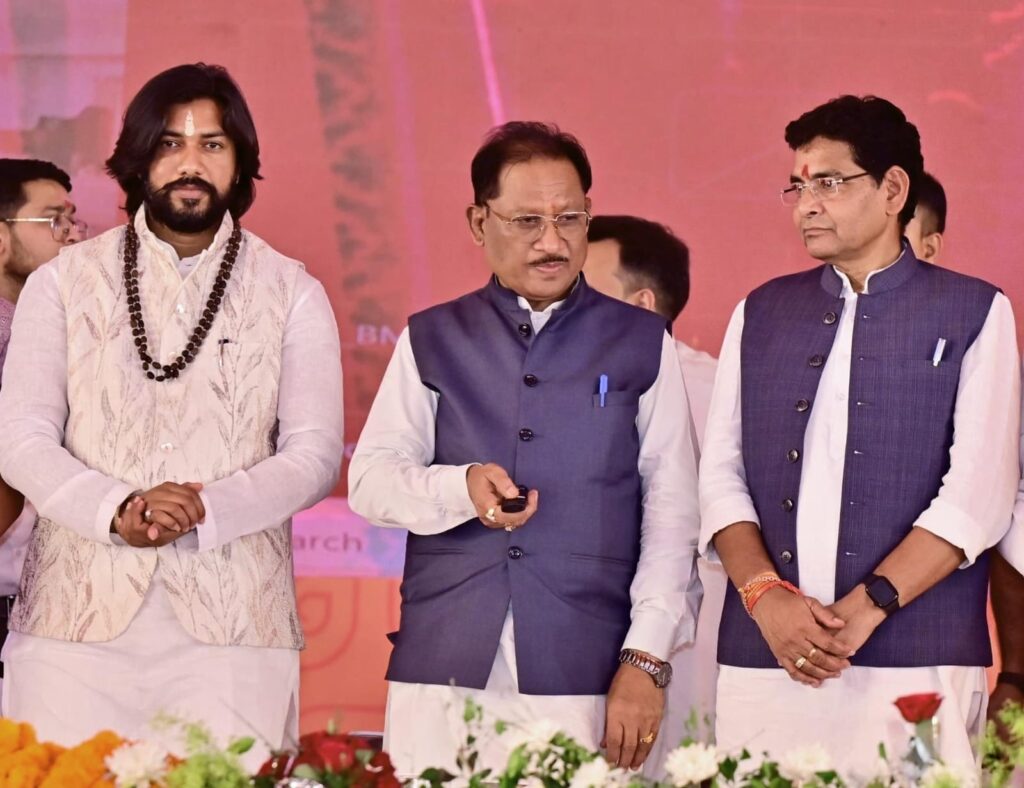
Referring to the Electricity Bill Resolution Scheme, the Chief Minister said the government is providing rebates and easy installment options to clear pending dues from the COVID-19 period. Camps are being organised across the state to facilitate quick resolution, with the scheme remaining active until June.
On internal security and development, Shri Sai noted that regions like Bastar, once affected by Naxalism, are witnessing rapid transformation with improved peace and development. He credited coordinated efforts by the Centre and security forces for the positive change, adding that development initiatives are now reaching previously affected areas.
The Chief Minister also interacted virtually with beneficiaries from five districts to assess the impact of government schemes and reviewed departmental stalls set up at the venue.
Speaking on the occasion, Revenue Minister Tank Ram Verma said the government has set new benchmarks in delivering welfare schemes with transparency and efficiency. He highlighted that direct benefit transfers have strengthened public trust while ensuring accountability in governance.
Other dignitaries present included Technical Education Minister Guru Khushwant Saheb and former Assembly Speaker Gaurishankar Agarwal, along with several public representatives and officials.
The large-scale fund transfer under the landless labour welfare scheme is being seen as a significant step in reinforcing the state’s commitment to inclusive development, ensuring that economic support reaches even the most vulnerable sections of society.