
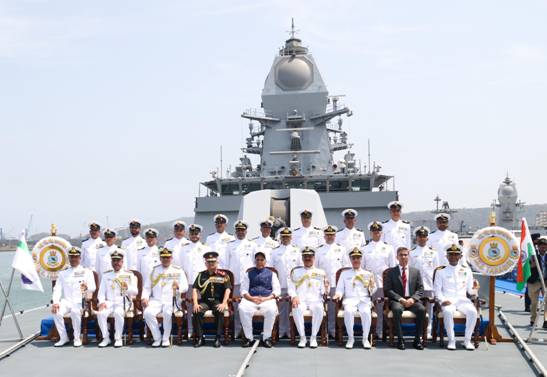
Warship showcases India’s growing naval strength, indigenous defence capability and technological advancement
TFP Bureau, Visakhapatnam, April 3, 2026: The Indian Navy on Friday commissioned its latest stealth frigate, INS Taragiri, at a ceremonial event held in Visakhapatnam in Andhra Pradesh. The warship was formally inducted into service in the presence of Defence Minister Rajnath Singh, marking a significant milestone in India’s naval modernisation and indigenous defence manufacturing.
INS Taragiri is the fourth stealth frigate under the advanced Project 17A class and has been designed by the Warship Design Bureau and constructed by Mazagon Dock Shipbuilders Limited with support from numerous micro, small and medium enterprises across the country. The vessel, with a displacement of about 6,670 tonnes, is equipped for multi-role operations and incorporates advanced stealth features that significantly reduce its radar signature, giving it a strategic advantage in modern naval warfare.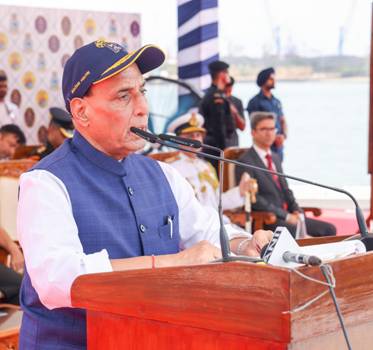
Addressing the commissioning ceremony, Rajnath Singh described INS Taragiri as more than just a warship, calling it a symbol of India’s expanding technological capability, self-reliance and formidable naval power. He emphasized that the vessel represents the growing strength of the country’s indigenous defence manufacturing ecosystem.
The Defence Minister noted that the warship is capable of high-speed deployment and can remain operational at sea for extended durations. It is fitted with sophisticated surveillance and combat systems, including advanced radar and sonar equipment as well as powerful missile systems such as the BrahMos supersonic cruise missile and modern surface-to-air missile systems. These systems enable the ship to effectively monitor threats, defend itself and launch swift counterattacks when required.
He said the ship is designed to handle a wide range of missions, including high-intensity naval combat, maritime security operations, anti-piracy patrols, coastal surveillance and humanitarian assistance. According to him, the platform strengthens the Navy’s ability to respond quickly to challenges in the maritime domain.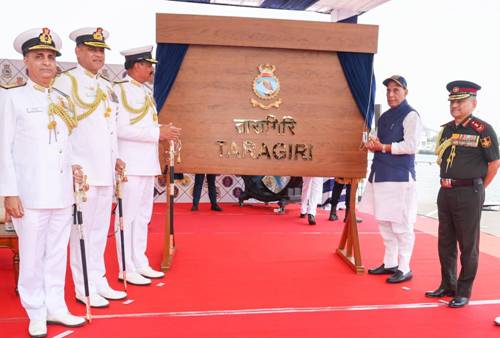
Highlighting India’s maritime importance, the Defence Minister pointed out that the country has a coastline of over 11,000 kilometres and is surrounded by sea on three sides. Nearly 95 percent of India’s trade is conducted through maritime routes, while the nation’s energy security also depends heavily on sea-based supply chains. In this context, he stressed that maintaining a strong and capable navy has become an absolute necessity for safeguarding national interests.
Rajnath Singh said the Indian Navy maintains continuous operational presence across the Indian Ocean Region, ensuring security and stability amid global uncertainties. He added that the Navy actively safeguards critical sea lanes and strategic choke points to ensure the uninterrupted flow of global trade.
He further noted that in the digital era, a majority of the world’s data travels through undersea internet cables, making the protection of maritime infrastructure equally important. The Navy, he said, is also focused on protecting such digital infrastructure that is closely linked with national security and economic stability.
The Defence Minister said that whenever crises arise, including evacuation missions or humanitarian relief operations, the Indian Navy consistently stands at the forefront. The induction of INS Taragiri, he added, will further strengthen the Navy’s operational capabilities and its commitment to protecting India’s maritime interests.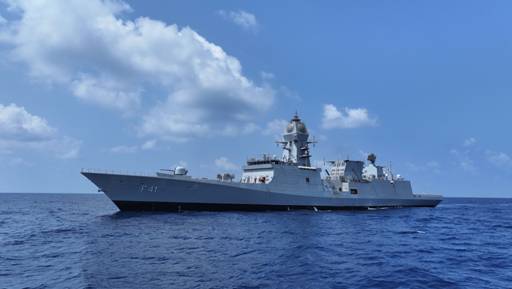
Reaffirming the government’s focus on defence self-reliance, Rajnath Singh said the country’s defence manufacturing sector has expanded significantly under the leadership of Narendra Modi. He highlighted that India’s defence exports have grown dramatically, reaching about ₹38,424 crore in the financial year 2025–26 compared to around ₹1,200 crore over a decade ago.
Chief of Naval Staff Dinesh K Tripathi also addressed the gathering and spoke about the historic legacy associated with the name Taragiri. He recalled the earlier Leander-class frigate commissioned in 1980, which played a key role in enhancing India’s anti-submarine warfare capabilities.
Admiral Tripathi emphasized that the evolving geopolitical and security landscape of the Indian Ocean demands a combat-ready and technologically advanced naval force. He reiterated the Navy’s commitment to remain a credible, cohesive and future-ready force capable of protecting national maritime interests at all times.
The commissioning ceremony included the ceremonial breaking of the Commissioning Pennant and the hoisting of the national flag aboard the ship for the first time. Among those present were Chief of Defence Staff Anil Chauhan, Eastern Naval Command chief Sanjay Bhalla and Chairman and Managing Director of Mazagon Dock Shipbuilders Limited Jagmohan.
INS Taragiri represents a significant technological leap over earlier frigate designs, featuring a sleeker structure and reduced radar cross-section that enhances its stealth capabilities. With more than 75 percent indigenous content and contributions from over 200 MSMEs, the warship reflects the maturity of India’s domestic defence industrial ecosystem.
Powered by a Combined Diesel or Gas propulsion system and equipped with an advanced Integrated Platform Management System, the ship is designed to undertake a wide range of missions with speed, efficiency and flexibility.
As the frigate joins the Eastern Fleet along India’s eastern seaboard, it carries forward the legacy of its predecessor while reinforcing India’s ability to build and operate sophisticated naval platforms domestically. The commissioning of INS Taragiri sends a strong message about India’s growing capability to design, build and deploy complex warships while contributing to regional maritime stability.